

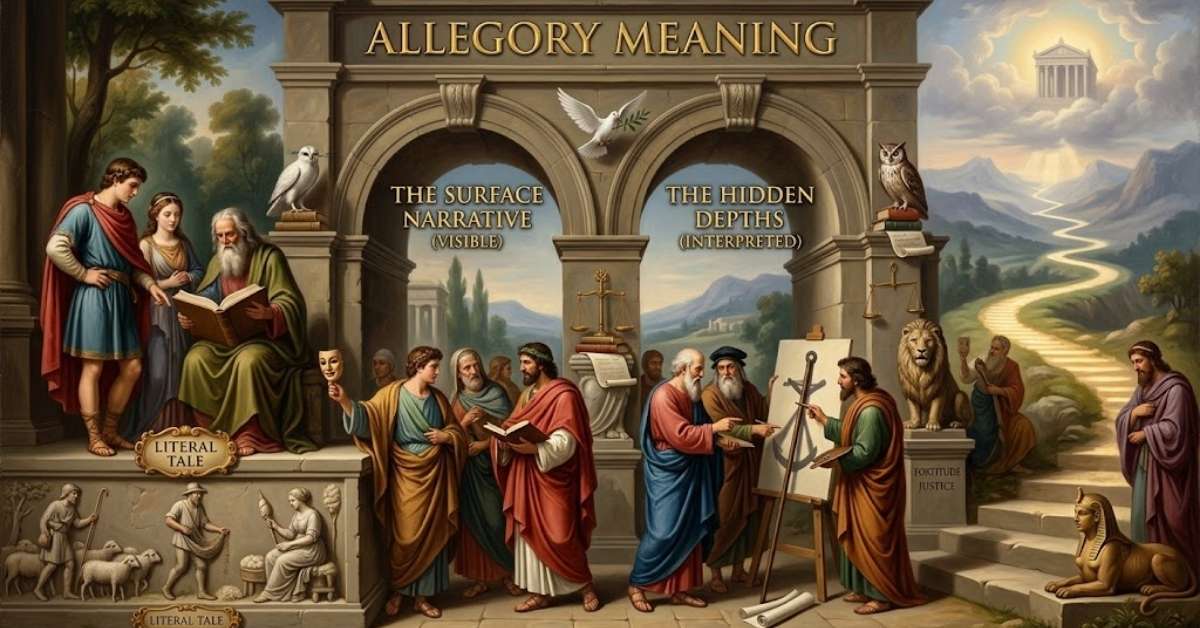
Ever finished a story and felt it was secretly about something else? Maybe you wondered why a talking pig in a farmyard felt so political. That nagging feeling is usually an allegory at work.Allegory meaning in one line: it’s a story where characters, events, and settings stand for abstract ideas. The surface tale is simple. The hidden meaning underneath is the real point.
Think of it as a lesson wearing a disguise. You read about a journey, a cave, or a farm. You walk away understanding power, truth, or faith.Stick around, and you’ll learn how to spot one, how cultures use them, and how to talk about them without sounding stiff.
Definition & Core Meaning
Core Meanings of Allegory
The allegory definition is a symbolic narrative that carries a layered meaning. The literal plot works on its own. The deeper meaning sits one level below.
In an allegory, characters as symbols, events as symbols, and settings as symbols all work together. Nothing is random. Every piece points to a moral meaning, a philosophical meaning, or a political meaning.
Simple Examples
Picture a tortoise slowly beating a hare. On the surface, it’s a race. Underneath, it’s a lesson about patience and teaching through metaphor.
Here’s a grown-up version. In Animal Farm, the pigs stand for Soviet leaders, and the farm stands for a nation. You can enjoy the story as a barnyard drama, but the political critique hits harder once you see the code.
Historical & Cultural Background
Ancient Meanings
The word comes from the Greek allēgoria, which roughly means speaking otherwise. Ancient allegory let writers say one thing while meaning another. Greek philosophy loved the trick.
The most famous case is Plato’s Allegory of the Cave. Prisoners watch shadows on a wall and think that’s reality. One escapes, sees the sun, and learns the difference between illusion and knowledge. Ancient philosophers used stories like this to explain ethics and truth without a lecture.
Cultural Interpretations
Every culture grew its own version. Religious texts used stories to pass on spiritual lessons and moral lessons to people who couldn’t read. A tale was easier to remember than a rule.
Over time, cultural interpretations shifted. A story that meant one thing in a medieval church might mean something else in a modern classroom. That’s the meaning shifts problem, and it’s part of why allegories stay alive.
Emotional & Psychological Meaning
Identity & Self-Reflection
Allegories work because they give you symbolic distance. You’re not looking at your own life. You’re looking at a knight, a storm, or a maze, and you see yourself anyway.
That makes identity and self-reflection safer. You can try on multiple perspectives and ask which values and beliefs feel true. Personal interpretation matters here, because two readers can find different truths in the same tale.
Healing & Mindset
Therapists and writers both know that healing through stories is real. Someone processing a loss might write a tale about a bird that can’t fly home. It’s not about the bird. It’s trauma processing in a form that doesn’t overwhelm.
Allegory also builds empathy. When you follow a character through inner struggles, you gain emotional insight into people you’ve never met. That shift in mindset can change how you treat others.
Different Contexts & Use Cases
Personal Life
You use personal life allegory more than you think. Calling a rough year “a long winter” is a tiny allegory. You turn emotional experiences into a picture that others can feel.
Some people go further and journal in symbols. A messy house becomes a mind. A locked door becomes a fear. It’s strange at first, but it can make hard feelings easier to name.
Social Media
Social media storytelling loves allegory. Think of captions that describe a lost balloon when the poster is really talking about a breakup. Followers get it without a single name mentioned.
Storytelling threads and art posts use the same move. A drawing of a lone lighthouse might speak to modern loneliness. You don’t have to explain it, and that’s the charm.
Relationships
In relationship communication, allegory softens hard topics. Saying “we’re two boats drifting apart” lands gentler than “you never listen.” It opens a talk instead of starting a fight.
A trust allegory works well too. Imagine trust as a glass bridge. It’s strong, but one crack changes how you cross. Partners often remember a picture longer than a speech.
Professional or Modern Usage
Professional usage is everywhere. Teachers use education stories to explain tough ideas. Writers use literature to critique power. Filmmakers use film allegory to talk about fear, social control, or politics without naming real people.
Marketers and leaders do it too. “We’re building a ship, not renting a raft” frames a company culture in a single image. It’s quick, and people repeat it.
Hidden, Sensitive, or Misunderstood Meanings
Common Misunderstandings
Many people think allegory and symbolism are the same thing. They’re close, but not identical. A symbol can appear once. An allegory sustains it across a whole story.
Another myth says every story hides a secret code. It doesn’t. Some tales are just tales. Misunderstood meanings often come from readers hunting for puzzles that the author never built.
What People Miss
People often miss that ambiguous allegory is deliberate. A writer may want multiple interpretations. Forcing one answer can flatten the work.
They also miss sensitive contexts. A story about a plague might echo real grief, and indirect communication may be the only safe way to speak. Read with care, and don’t assume the author’s pain is a puzzle to solve.
Comparison Section
Allegory vs metaphor confuses plenty of readers. The table below clears it up fast. Notice how length and purpose set each one apart.
| Form | What It Does | Length | Example |
| Allegory | Extended symbolic narrative with sustained symbolism | Full story | Animal Farm |
| Metaphor | Compares two things directly | A phrase | “Time is a thief” |
| Symbolism | One object stands for an idea | A moment | A dove for peace |
| Parable | Short moral story or religious story | Brief | The Good Samaritan |
| Fable | Short tale with animals and a lesson | Brief | The Tortoise and the Hare |
| Satire | Uses humor and irony for social critique | Varies | Gulliver’s Travels |
Here’s the quick rule. A metaphor is a flash. An allegory is a whole movie.
Popular Types & Variations of Allegory
1. Moral Allegory
Moral allegory teaches virtue and the difference between right and wrong. Characters often carry names like Hope or Greed. The lesson is hard to miss.
The Pilgrim’s Progress by John Bunyan follows a traveler through temptations. Each stop is a test of character.
2. Political Allegory
Political allegory tackles power and governance. It often exposes authoritarian control in a form that’s harder to censor.
Orwell’s Animal Farm is the classic. Arthur Miller’s The Crucible also works as a veiled response to the McCarthy era.
3. Religious Allegory
Religious allegory explains faith and divine truths through story. Parables are the best-known form, since they pack big ideas into small scenes.
Dante’s Divine Comedy goes bigger. It maps a soul’s journey through hell, purgatory, and heaven.
4. Philosophical Allegory
Philosophical allegory makes abstract concepts easier to grasp. Plato’s cave does this beautifully. It turns a heavy question about reality into a picture you can’t forget.
These stories invite philosophical exploration. You’re meant to argue with them, not just nod.
5. Psychological Allegory
Psychological allegory shows inner conflict through outer events. Emotions as symbols take shape as monsters, storms, or dark forests.
Think of a character who fights a shadow version of himself. That’s not a fight scene. It’s a mind arguing with itself.
6. Social Allegory
Social allegory points at class inequality and other cultural issues. It holds up a mirror to how a group treats its members.
Dystopian novels do this often. A walled city might represent a society that hides its poor.
7. Historical Allegory
Historical allegory retells real events through symbols. Revolutions, wars, and collapses become stories with new faces.
The distance helps. Readers can judge the past more honestly when the names are changed.
8. Environmental Allegory
Environmental allegory shows human impact on nature. A greedy town cuts down the last tree, and climate damage arrives like a slow punishment.
Dr. Seuss’s The Lorax is a gentle example. Kids hear a story. Adults hear a warning.
9. Personal Allegory
Personal allegory turns individual experiences into symbolic tales. Dreams as narratives fit here, since a dream already speaks in images.
Writers use it to process their own lives. A story about climbing a mountain can quietly mean surviving an illness.
How to Spot an Allegory in Any Story
Want a quick test? Ask three questions. Does the story feel too neat? Do names or places seem oddly symbolic? Does it keep pointing at one big idea?
Then try story analysis step by step. List the main characters, match each to an idea, and check if the pairing holds across the plot. If it does, you’ve likely found a sustained symbolism pattern.
Here’s a small checklist you can use:
- Characters feel like types, not people
- Settings carry weight beyond the scene
- Events repeat a theme from a different angle
- The ending delivers a lesson, not just a result
How to Respond When Someone Asks About It
Casual Responses
Someone asks, “What’s an allegory?” Keep it light. Say, “It’s a story with a secret second meaning.” That’s honest, short, and easy to follow.
You can add an example if they look curious. “Like Animal Farm, where animals stand for real leaders.” Done.
Meaningful Responses
If the person wants depth, go slower. Explain that allegory uses truth through symbols to teach moral teaching or social commentary. Then share one story that moved you.
Personal stories stick. They show you understand the idea, not just the definition.
Fun Responses
Try a joke. “It’s a story wearing a trench coat, pretending to be about something else.” People laugh, and then they remember it.
Another option is a game. Ask a friend to guess what a children’s movie is really about. You’ll both be surprised.
Private Responses
Sometimes the question is personal. A friend may ask because they’ve written a story about their own pain. Respond gently, and don’t push for the “real” meaning.
Say, “I felt something in that story. Want to talk about it?” That’s respectful, and it leaves the door open.
Regional & Cultural Differences
Western Cultures
Western traditions lean on Western literature to deliver political critique and moral debate. From Aesop to Orwell, the habit is to use story as an argument. Literary device and plot often serve the lesson.
Western readers also enjoy decoding. Allegory becomes a puzzle, and the pleasure is in solving it.
Asian Cultures
Asian cultures often favor harmony and wisdom over blunt critique. Zhuangzi’s tale of dreaming he was a butterfly asks who’s dreaming whom. It’s gentle, and it lingers.
Journey to the West blends adventure with spiritual traditions. The monkey king’s wild path mirrors the struggle to master the self.
Middle Eastern Cultures
Middle Eastern cultures have a rich poetic traditions line. Attar’s The Conference of the Birds sends birds on a quest to find their king. The journey becomes a map of the soul.
Rumi’s stories do similar work. A small tale about a reed flute carries a lot of longing.
African & Latin Cultures
African cultures and Latin cultures treasure oral storytelling. Anansi tales from West Africa use a clever spider to teach community values. They also preserve wisdom and ancestry across generations.
In Latin America, writers like García Márquez blur fact and fantasy. One Hundred Years of Solitude is often read as an allegory of the region’s history.
Allegory in Films, Games, and Everyday Media
Films, novels, and games carry allegory too. The Matrix echoes Plato’s cave. Many fantasy series treat dark lords as stand-ins for real tyranny.
You’ll spot it in media more often once you know the pattern. Next time you watch something, ask what the world is really about.
Why Allegory Still Matters Today
We live in a noisy time. Direct language gets lost in the scroll. Indirect expression can slip past defenses and make people think.
Allegory also protects speech. Under strict regimes, writers have used hidden messages to say what they couldn’t say plainly. That role hasn’t disappeared.
Conclusion
Allegory is a literary device and a figurative language tool that has lasted thousands of years. It works because symbolic storytelling meets people where they are. You feel the idea before you name it.
Now it’s your turn. What’s the best allegory you’ve ever read or watched? Drop it in the comments, and share this with a friend who loves stories with secrets.
FAQs
What is the simple meaning of allegory?
It’s a story where characters and events stand for bigger ideas. The plot works on its own. The deeper interpretation adds a second layer about morals, politics, or life.
What is the difference between allegory and metaphor?
A metaphor is a short comparison. An allegory is an extended symbolic narrative that runs through an entire work.
Is Animal Farm an allegory?
Yes. It’s a political allegory about the Russian Revolution and the rise of Soviet power. The farm animals stand for real groups and leaders.
Is Plato’s Allegory of the Cave a real story?
No. Plato created it as a thought experiment in The Republic. It explains how people mistake illusion and knowledge.
Can an allegory have more than one meaning?
Yes. Many have multiple interpretations, and good ones invite debate. Context and culture can shift the reading over time.
Why do authors use allegory?
Authors use it to teach, critique, or comfort without direct language. It can also protect them when the truth is risky to say plainly.
