

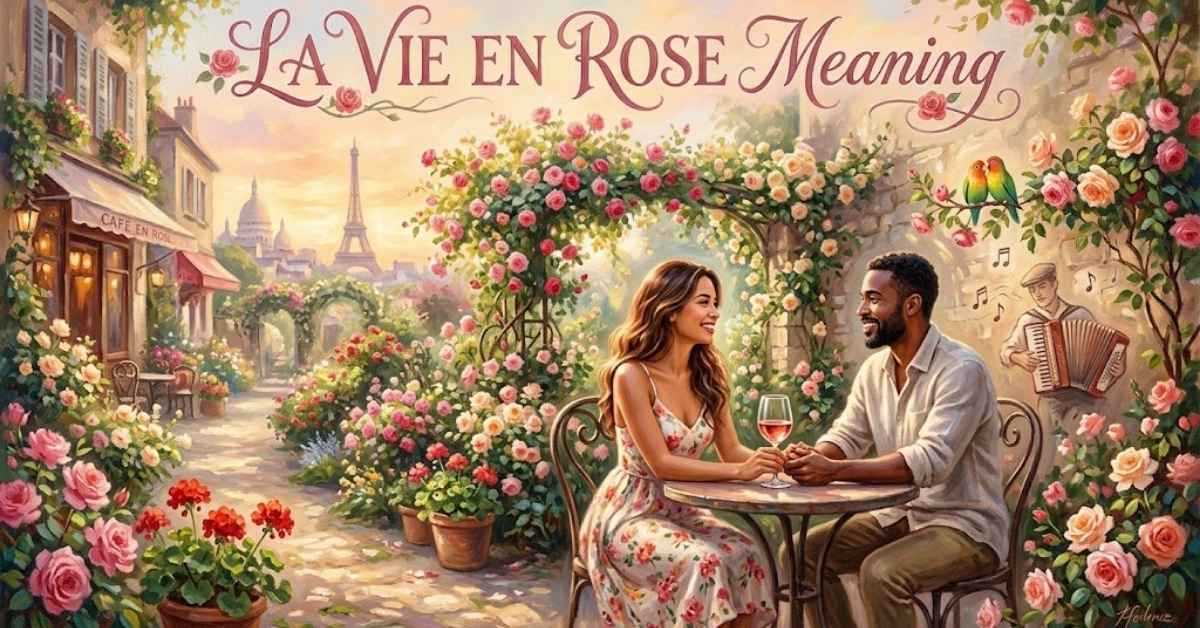
Ever heard someone say “la vie en rose” and wondered if they meant love, luck, or just a good mood? Maybe you saw it under a Paris photo and felt like you were missing the joke.La Vie en Rose meaning is simple. It’s a French expression that translates to “life in pink,” and it describes seeing life positively, usually because of love or deep happiness.
Think of it as the French version of rose-colored glasses.Here’s the full story. You’ll get the literal translation, the history behind it, and how people use it today. You’ll also learn when it’s sweet and when it’s a warning sign.
Definition & Core Meaning
Core Meanings of La Vie en Rose
Literally, La Vie en Rose means “life in pink.”
Pink symbolism matters here, because pink stands for tenderness, warmth, and softness.
Figuratively, it means looking at the world through a romantic perspective.
Problems shrink, everyday beauty grows, and you feel emotionally warm about it all.
Simple Examples
Say you just started dating someone wonderful.
Even your Monday commute feels pleasant, and you’d say “I’m seeing life in pink lately.”
Here’s one more.
A friend returns from a trip glowing, so you tease, “Still living la vie en rose, huh?”
Historical & Cultural Background
Origins in Language and Art
The phrase comes from the older French idiom “voir la vie en rose.”
That idiom has been part of French language and French culture for a long time, and it uses pink as a poetic metaphor for hope.
Then Édith Piaf made it famous.
Her 1945 French song, released to the public in 1947, turned a French phrase into a global love anthem.
Cultural Interpretations
In France, the cultural significance leans romantic and a bit wistful.
It’s tied to Paris, French music, and the idea that love can transform ordinary days.
Elsewhere, the phrase traveled through film, jazz covers, and the 2007 biopic about Piaf.
That’s how a French cultural context became a universal metaphor for joy.
Emotional & Psychological Meaning
Personal Growth
Seeing life in pink can nudge you toward personal growth.
When you feel hopeful, you try more, stay curious, and bounce back faster.
That’s emotional resilience in action.
You don’t ignore the hard stuff, you just refuse to let it be the only story.
Identity & Self-Perception
Some people have a romantic personality and naturally notice beauty everywhere.
Others build this habit slowly, one gratitude mindset moment at a time.
Either way, your self-perception shifts.
You start seeing yourself as someone who finds beauty in life, and that changes your choices.
Healing, Mindset & Symbolism
Psychologists often point to positivity bias, our tendency to expect good outcomes.
Researchers like Tali Sharot found that most people lean optimistic about their own futures.
That can support emotional healing and emotional recovery.
Reframing difficult experiences isn’t denial, it’s choosing which part of the picture you focus on.
Different Contexts & Use Cases
Personal Life
In everyday conversation, the phrase fits any simple moments that feel unusually sweet.
A slow morning coffee, a sunny walk, or a call with an old friend all count.
It’s a gentle way to say, “Life feels good right now.”
No big speech needed.
Social Media
On Instagram captions, la vie en rose pairs with dreamy visuals and soft visuals.
Pastel sunsets, café tables, and Paris rooftops are classic picks.
Brands use it too, especially in lifestyle branding and luxury branding.
It signals a curated lifestyle that feels aspirational and calm.
Relationships
In romantic relationships, it points to the honeymoon phase.
Your partner’s quirks look charming, and emotional intimacy feels effortless.
Healthy couples carry some of that glow forward.
They keep appreciating imperfections instead of waiting for them to vanish.
Professional or Modern Usage
At work, nobody says it in meetings.
But marketing positivity borrows the idea, with campaigns built around emotional storytelling.
In modern speech, it can also describe someone’s positive worldview about a new job or city.
Context decides whether it’s praise or a gentle eye roll.
Hidden, Sensitive, or Misunderstood Meanings
What People Get Wrong
Many people think it means being happy all the time.
It doesn’t, because healthy optimism still sees problems clearly.
Others assume it’s only about love.
Actually, gratitude, travel, and creative expression can all trigger it.
Cultural Misinterpretations
Learners sometimes translate it as “the pink life” and miss the point.
That’s a classic misinterpretation of French expressions, since idioms rarely work word for word.
Also, pink doesn’t carry the same meaning everywhere.
Cultural misinterpretation happens when we assume everyone reads symbolic color meaning the same way.
When Meaning Changes
Tone flips the meaning fast.
“You’re living la vie en rose” can sound sweet or sarcastic.
Sarcasm usually signals unrealistic optimism or denial of problems.
Listen to the voice and the situation, because context-dependent meaning rules here.
Comparison Section
Plenty of terms sound close, but they aren’t twins.
This quick table shows how la vie en rose stacks up against its neighbors.
| Concept | Core Idea | Key Difference |
| La Vie en Rose | Seeing life through love and beauty | Emotional and a bit dreamy |
| Optimism | Expecting good outcomes | Focused on the future |
| Happiness | A feeling of well-being | A state, not a lens |
| Idealism | Holding high standards or visions | Can ignore reality versus perception |
| Gratitude | Thankfulness for what exists | Rooted in the present |
| Naive optimism | Believing without evidence | Skips the balanced perspective |
So how do you tell them apart?
Ask whether the feeling is a mood, a belief, or a way of seeing.
Positive thinking versus romantic idealism is a good example.
One builds habits, the other can build fantasies.
Popular Types / Variations of La Vie en Rose
1. Romantic La Vie en Rose
This is the classic version.
You’re falling in love, and new love colors everything.
Your idealized partner looks perfect.
It feels magical, and honestly, it’s a lovely ride.
2. Emotional La Vie en Rose
Here, emotional warmth leads the way.
You feel tenderness toward people, places, and memories.
It often shows up after a long hard season.
Joy returns softly, and you notice it.
3. Travel La Vie en Rose
Ever landed somewhere new and everything looked magical?
That’s vacation happiness, and Paris gets the credit most often.
Your brain loves novelty, so even a bakery line feels special.
Those travel memories can last for years.
4. Aesthetic La Vie en Rose
This one lives in digital aesthetics.
Think blush tones, film grain, and Instagram lifestyle feeds.
It’s about visual storytelling more than depth.
Still, it can inspire people to notice beautiful moments offline.
5. Temporary La Vie en Rose
Some pink phases fade fast.
A fleeting emotional high after a great date or concert is a perfect example.
That’s short-lived happiness, and it’s okay.
Enjoy it fully, just don’t build a five-year plan on it.
6. Mindset La Vie en Rose
This version is a choice.
You practice choosing joy and an intentional outlook daily.
Small habits help, like writing three good things each night.
Over time, that builds life satisfaction without pretending.
7. Naive La Vie en Rose
Here’s the risky one.
It’s naive idealism, where red flags look like pink flags.
Maybe you ignore money problems or a partner’s disrespect.
That’s when negative consequences of idealization show up.
8. Healing La Vie en Rose
After loss or stress, small bright moments matter a lot.
This type supports emotional healing and recovery through positivity.
You’re not erasing pain.
You’re making room for hope next to it.
9. Creative La Vie en Rose
Artists, writers, and musicians often live here.
Artistic inspiration thrives when the world feels full of romantic imagery.
Piaf’s song itself proves the point.
It’s poetic expression that turned a feeling into art.
10. Spiritual La Vie en Rose
For some people, this means soul-level contentment.
Meditation and inner peace help them see life as a gift.
Gratitude and spirituality often travel together.
The result is calm, not giddiness.
How to Respond When Someone Asks About It
Casual Responses
Someone says, “What’s with the la vie en rose caption?”
Keep it light: “Just feeling good lately!”
Or try, “Life’s been sweet, that’s all.”
Short, friendly, done.
Meaningful Responses
If the person really wants to know, go deeper.
“It means seeing life through love and beauty, even on ordinary days.”
You can add a personal example.
“Since I started walking each morning, everything feels softer.”
Fun Responses
Humor works well here.
“I’m wearing my pink-colored glasses, and they’re on sale!”
Or, “Don’t pop my bubble, I’m enjoying it.”
Smiles guaranteed.
Private Responses
Not everyone wants to explain their joy, or their healing.
“It’s a personal thing, but thanks for asking” is perfectly fine.
You can also say, “It’s my little reminder to be gentle.”
Boundaries and warmth can coexist.
Regional & Cultural Differences
Western Cultures
In the US, UK, and much of Europe, the closest idiom is “rose-colored glasses.”
British speakers say “rose-tinted spectacles,” often with a slight warning attached.
Western cultural interpretation blends romance with caution.
It’s lovely, but “don’t lose touch with reality.”
Asian Cultures
Many Asian cultures value emotional balance and inner harmony.
Seeing beauty in small things, like seasonal flowers, matches the spirit of the phrase.
Pink may also link to spring and youth.
The idea feels familiar, even if the idiom isn’t.
Middle Eastern Cultures
In many Middle Eastern cultures, poetry and emotional expression run deep.
Love poems often paint the world in vivid, romanticized colors.
Gratitude plays a big role too.
Appreciation for family and hospitality fits the same warm outlook.
African & Latin Cultures
Across African cultures and Latin cultures, music and culture carry joy powerfully.
Dance, song, and shared emotional expression create collective happiness.
The idea of interconnectedness is strong.
Joy is rarely a solo act, and that feels very “la vie en rose.”
Why La Vie en Rose Still Matters in 2026
Our feeds are packed with bad news, so people crave small pockets of joy.
That’s why la vie en rose content keeps popping up in social media trends, from slow living to “soft life” posts.
Wellness circles are also talking about emotional well-being and balanced optimism.
So the phrase fits right in, as long as it comes with honesty.
How to Keep Your Optimism Healthy
Want the glow without the crash?
Try this simple list:
- Notice facts and feelings separately, so you don’t confuse them.
- Practice a gratitude mindset with one small note each evening.
- Ask a trusted friend how a decision looks from outside.
- Accept imperfect days without calling them failures.
That’s emotional maturity at work.
You keep the romantic outlook and add a balanced perspective.
Conclusion
La Vie en Rose means seeing life in pink, through love, optimism, and a softer lens. It’s beautiful when it’s grounded, and risky when it hides real problems.So, what does your version look like?
Drop a comment, share this with a friend who needs a little pink today, and tell us your favorite simple moment.
FAQs
What does La Vie en Rose mean in English?
It means “life in pink.” Figuratively, it’s seeing life positively, like wearing rose-colored glasses.
Is La Vie en Rose always about love?
No. Love is the usual trigger, but gratitude, travel, and creative expression can create the same feeling.
Can La Vie en Rose have a negative meaning?
Yes, sometimes. If someone says it sarcastically, it can suggest unrealistic optimism or ignoring reality.
Who made La Vie en Rose famous?
Édith Piaf did, with her signature song. It’s now one of the most recognized French songs in the world.
How do you use La Vie en Rose in a sentence?
“After the wedding, they spent a month living la vie en rose.” You can also say, “She sees everything en rose these days.”
