

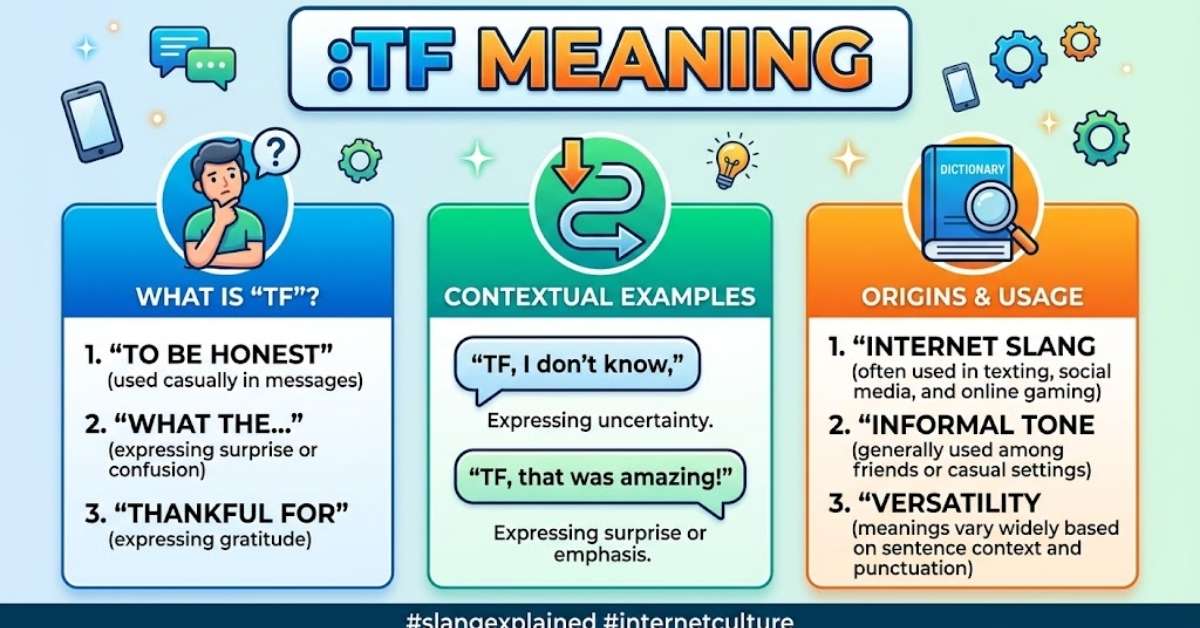
Someone texts you “tf is that supposed to mean?” and you freeze. Is it an insult? A joke? A typo?TF meaning in text is short for “the f*ck.” People use it to show surprise, anger, confusion, or disbelief in a message. It almost never stands alone. It follows a word like “who,” “what,” “why,” or “where” to turn a plain question into a loud one.
This guide breaks down what TF stands for, where it came from, and how to reply. You’ll also see when it’s safe to type and when it’ll get you in trouble.
Meaning & Definition
The TF definition is simple. It’s an internet abbreviation for “the f*ck,” a strong profanity that adds punch to a sentence. Think of it as the volume knob on a question.
Compare “Who is that?” with “Who tf is that?” The first one is curious. The second one is shocked or annoyed. The extra two letters carry all that feeling.
You’ll see TF slang most in casual conversations between friends. It belongs to informal language, and it’s not polite by any standard.
What Does TF Meaning in Text?
When people ask what does TF mean, they usually mean the version used in text messaging abbreviations. In that world, TF stands for “the f*ck,” and it works as an intensifier.
Here are the most common jobs it does in TF in texting:
- Surprise: “Where tf did you find that?”
- Anger: “Why tf would you say that?”
- Confusion: “What tf is happening right now?”
- Disbelief: “Who tf does that?”
Notice the pattern. TF sits right after a question word. That’s the sweet spot for TF usage, and it’s why the phrase feels natural to read.
Background / Origin
There’s no single documented moment when TF was born. It grew out of WTF, which spread through early chat rooms, internet forums, and instant messaging. People wanted to type less and say more.
As fast-paced digital communication took over, shortened expressions got even shorter. WTF lost its first letter, and TF became a cleaner way to drop the swear into the middle of a sentence. That’s the honest story of the TF origin: a gradual shift, not a viral moment.
It’s a good example of online language evolution. Slang rarely arrives with a birth certificate. It just shows up in enough messages that everyone starts to understand it.
Usage in Different Contexts
Meaning depends on context, and TF is a perfect case. The same two letters can sound playful in a group chat and rude in a work thread. Tone and context do the heavy lifting.
Let’s look at how it behaves in everyday life and in more serious spaces.
General Usage
In daily chats, TF works as a quick reaction. You’ll spot it in Instagram DMs, private messages, and WhatsApp conversations between people who know each other well.
Picture this: your friend sends a screenshot of a $14 coffee. You reply, “Why tf is it that expensive?” Nobody gets offended. Everyone laughs.
It also shows up when someone is frustrated. “Where tf are my keys” isn’t aimed at anyone. It’s just steam coming out.
Formal vs Informal Usage
In formal communication, TF has no place. Professional emails, cover letters, and academic writing call for polite language. Typing “what tf” to your manager is a fast way to land in an awkward meeting.
In informal communication, the rules relax, but not completely. Even among friends, some people dislike swearing. Read the room first.
Here’s a quick comparison:
| Setting | Is TF okay? | Better option |
| Work email | No | “I’m confused by this.” |
| Class essay | No | “This seems unclear.” |
| Group chat with friends | Usually | Keep it light |
| Chat with a new crush | Risky | “Wait, what?” |
| Gaming voice or text chat | Common | Match the lobby |
TF Meaning on Social Media Platforms
Social media slang moves fast, and TF travels everywhere. Each app gives it a slightly different flavor, so let’s walk through the big ones.
On TikTok, TF pops up in TikTok captions and social media comments when a video shocks people. “Who tf approved this” is a classic reply under a wild clip. On Instagram, it lands in comments and Instagram DMs, often paired with an emoji like 😭.
On Snapchat, Snapchat reactions tend to be quick and unfiltered, so TF fits right in. On WhatsApp, you’ll see it in casual chats, though family groups usually keep it clean. On X (formerly Twitter), TF shows up in jokes and replies, while Reddit slang leans toward the full phrase in longer posts. In meme culture, TF is a loved reaction line for viral content that makes people go “huh?”
Other Meanings in Different Fields
Here’s where it gets interesting. TF isn’t only a swear shortcut. Outside digital communication, the same letters mean very different things.
- Transferrin: In medical abbreviations, Tf refers to transferrin, an iron transport protein in the blood.
- TensorFlow: In technology abbreviations, “tf” is the common short name for TensorFlow, Google’s machine learning framework.
- Term frequency: In search and computing terminology, TF counts how often a word appears in a document. You’ll see it in “TF-IDF.”
- Transfer function: In physics abbreviations and engineering, it describes how a system turns an input into an output.
- Team Fortress: In online gaming communities, “TF2” points to the shooter game Team Fortress 2.
- Task force: In government and business, TF can mean a group assembled for one job.
So if a developer says “import tf,” they’re not swearing. They’re loading a code library. Context settles every one of these.
Examples of TF Meaning in Text in Sentences
Examples make slang click. Below are TF examples that show how TF in sentences looks in real chats. Each one has a different emotion behind it.
- “Who tf left the oven on?” (frustration)
- “Wait, what tf just happened?” (shock)
- “Why tf are you awake at 4 a.m.?” (confusion)
- “Where tf did that come from?” (surprise)
- “How tf did she pass that exam without studying?” (disbelief)
- “Bro, what tf, I just paid for that!” (anger)
You can also hear the humor in some of them. Exaggerated reactions are part of the fun, especially when everyone in the chat is joking along.
Common Misconceptions
Misunderstanding slang happens all the time, and TF gets its share. Let’s clear up a few myths.
First, TF doesn’t always mean someone’s angry. It can signal humor or amazement just as easily. A friend writing “how tf did you do that” after your perfect parking job is impressed, not upset.
Second, TF isn’t “thank f*ck,” even though some people guess that. It’s also not always aimed at you. Often it describes a situation, not a person.
Third, some people assume it’s harmless because it’s short. It’s still offensive language to many readers, so appropriate slang usage matters.
Similar Terms & Alternatives
TF has plenty of cousins. Knowing them helps you read text slang faster and pick softer options when you need to.
Similar slang terms include WTF (“What the F*ck”), OMG (“Oh My God”), SMH (“Shaking My Head”), IDK (“I Don’t Know”), and FR (“For Real”). Each carries a different mood.
If you want alternative expressions without the swear, try these:
- “What the heck”
- “What on earth”
- “Wait, what?”
- “How come?”
- “Seriously?”
These keep the emotion but drop the vulgar expressions. They’re safer for mixed company.
How to Respond to TF Meaning in Text When Someone Uses It
Your reply depends on who sent it and what they felt. Start by reading the whole message, not just those two letters.
If they sound upset, stay calm and ask for clarification. Something like “Sorry, what part confused you?” works well. If they sound amused, match the energy with a joke or an emoji.
Here are replies to TF messages that fit most situations:
- Friend being funny: “Right? I couldn’t believe it either 😂”
- Friend frustrated: “I get it. Want me to help fix it?”
- Unclear tone: “Is that a good wow or a bad wow?”
- Someone you don’t know well: “Not sure what you mean. Can you explain?”
Good communication etiquette means you don’t escalate. A short, steady answer beats a defensive one every time.
Difference Between TF Meaning in Text and Similar Terms
People often mix up TF vs. WTF. The difference between TF and WTF comes down to placement and punch. WTF usually stands alone as a full reaction: “WTF.” TF slides into a sentence: “Who tf is that?”
Think of WTF as a shout and TF as an underline. One ends the thought. The other adds weight to it.
Here’s a simple slang comparison:
| Term | Full form | Typical use | Feel |
| TF | The f*ck | Mid-sentence intensifier | Casual, sharp |
| WTF | What the f*ck | Standalone reaction | Louder, more direct |
| OMG | Oh my God | Surprise or excitement | Milder, widely accepted |
| SMH | Shaking my head | Disapproval | Calm, judgmental |
| IDK | I don’t know | Uncertainty | Neutral |
| FR | For real | Agreement or emphasis | Friendly |
Relevance in Online Conversations & Dating Apps
In online conversations, TF stays popular because it’s fast. Younger audiences love it for concise messaging, and it fits the pace of group chats and gaming chat.
On dating app conversations, though, think twice. Online dating slang can be playful, but swearing early on can feel harsh. “What tf, you like pineapple pizza?” might land as teasing with one person and as rude with another.
A safer move is to wait until the vibe is clear. If your match swears first and jokes a lot, you’ve got the green light. If they write in clean, careful sentences, mirror that style.
Is TF Rude or Offensive?
It depends on the audience. TF is profanity, so it’s rude in professional settings and around people who dislike swearing. Among close friends, many people treat it as background noise.
A good test: would you say the full phrase out loud in that room? If the answer is no, don’t type the short version.
Platforms matter too. Some workplaces, schools, and apps filter or flag swearing. That makes slang etiquette more than a manners issue. It can affect your account or your job.
TF in Gaming Chat and Online Communities
Gaming chat is one of the busiest homes for TF. In fast matches, nobody has time to type “what the f*ck just happened.” So TF gets the job done in a heartbeat.
In online gaming communities, you’ll see it after a surprise kill, a laggy moment, or a teammate’s odd choice. “Who tf picked that character?” is a typical line. It’s less about hate and more about heat of the moment.
Keep in mind that some servers have strict rules. Moderators may mute swearing, so check the community guidelines before you type.
Quick Tips Before You Use TF
A few habits will keep you out of trouble. They’re simple, and they work.
- Know your audience. Friends and teammates are fine. Bosses and teachers aren’t.
- Check the mood. If the chat is serious, skip it.
- Don’t aim it at people. Directed at someone, it can read as an insult.
- Offer a clean backup. “What the heck” does the same job.
- Watch for mixed meanings. In a tech or medical chat, TF may mean something else.
Treat these as guardrails, not rules carved in stone. You’ll pick up the feel quickly.
Conclusion
TF is a small abbreviation with a big attitude. It’s short for “the f*ck,” and it adds strong emotional reactions to a message: shock, frustration, confusion, or pure amazement. Outside chats, it can also mean transferrin, TensorFlow, or term frequency, so context is everything.
Use it with friends, avoid it at work, and read the tone before you reply. That’s the whole playbook.Did this clear things up? Drop a comment with the weirdest “tf” text you’ve ever received, and share this guide with the friend who keeps asking what it means.
FAQs
What does TF mean in text?
TF means “the f*ck.” People add it to questions to show surprise, anger, or confusion, like “who tf is that?”
Is TF the same as WTF?
Not exactly. WTF is “what the f*ck” and often stands alone. TF usually sits inside a sentence to add emphasis.
Is TF a bad word?
Yes, it’s profanity. It’s fine among close friends in many cases, but it’s unsuitable for formal or professional messages.
What does TF mean on TikTok or Instagram?
It works the same way: a quick reaction to something shocking or funny. You’ll see it in comments, captions, and DMs.
Can TF mean something other than a swear?
Yes. It can mean transferrin in medicine, TensorFlow in tech, term frequency in search, or Team Fortress in gaming.
How should I reply if someone sends me TF?
Read the tone first. If it’s playful, joke back. If it sounds upset, ask what confused them and stay calm.
Should I use TF on dating apps?
Go carefully. Wait until you know your match’s style, or pick a softer phrase like “wait, what?”
Is TF okay in professional emails?
No. Use polite language and clear wording in work messages and academic writing.
