

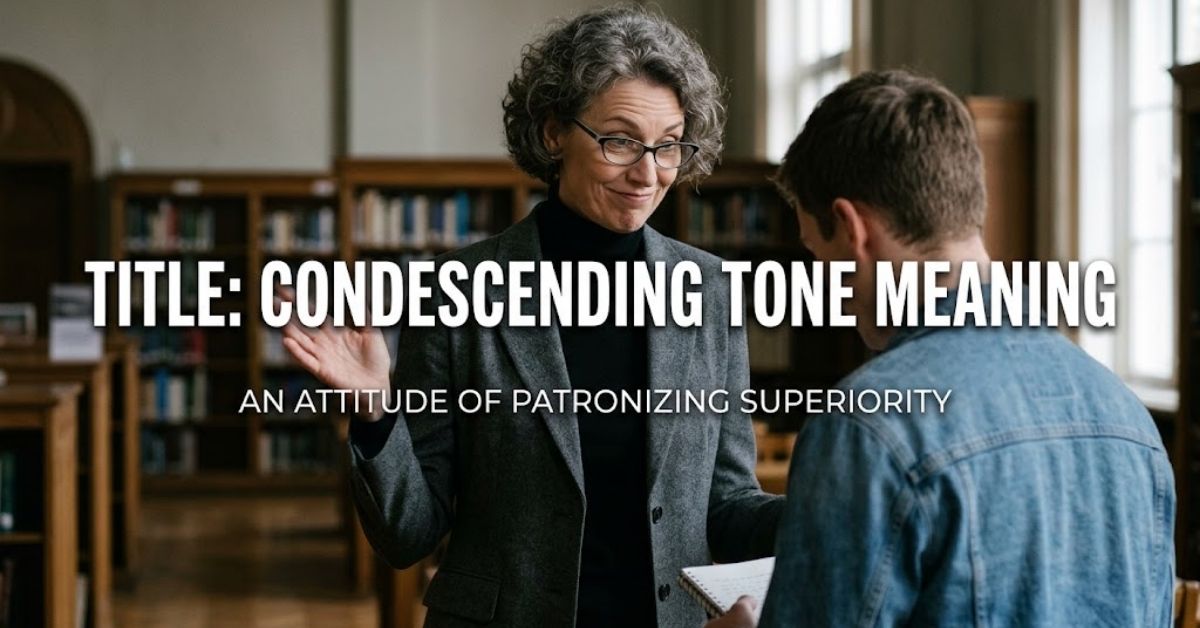
Condescending means acting like you’re smarter or better than someone else. It’s talking down to someone while pretending to help. The condescending meaning lives in the attitude, not just the words.Ever had a coworker say “Let me explain this to you” after you’ve done the job for six years? Or felt a small sting from a “Good for you!” that wasn’t really kind? You’re not being oversensitive.
This guide shows what it sounds like, why people do it, and how to respond without losing your cool. Grab a coffee. Then tell us in the comments which example hit closest to home.
What Does Condescending Mean?
Condescending is an adjective. It describes a superior attitude where one person treats another as less capable. The Cambridge Dictionary frames it as showing that you feel better than others.
The word meaning has a funny past. It once described kindly stepping down to someone’s level. Today it only carries the sting of looking down on others.
Simple Definition
Think of it as acting superior with a smile on. Someone treats you like you can’t handle basic facts, even when you can.
Here’s a quick test. Does their tone of voice make you feel smaller? Then it’s probably condescending behavior, whatever words they picked.
What Is the Difference Between Condescending and Condescension?
Condescending describes the person or the action. Condescension is the noun. It names the behavior itself.
So you’d say “his condescending remarks annoyed me.” You’d also say “I couldn’t miss the condescension in his voice.”
Same idea, different grammar. One is a label, the other is a thing you can feel in a room.
What Does a Condescending Person Act Like?
A condescending person often overexplains simple things. They interrupt others, sigh before answering, and treat your questions as a nuisance. You walk away feeling like a student who forgot homework.
Watch the body language too. A condescending smile, smirking, or a slow eye roll can say more than words. These nonverbal communication cues often show up before the first insult.
The pattern matters most. One bad moment is human. Repeated behavior is a behavioral pattern, and that’s where the real damage starts.
Examples of Condescending Behavior
Real life shows this better than any definition. Here are five everyday spots where condescending behavior hides in plain sight.
At Work
Picture a manager who re-explains your own report to you in a meeting. Everyone’s watching, and you feel your confidence drain. That’s workplace communication gone wrong.
Another classic is the coworker who hands out unwanted advice about a task you finished last year. It’s rarely about help. It’s about power dynamics.
In a Conversation
You mention a book you loved. A friend replies “Oh, I’m surprised you know that.” The dismissive tone turns a nice chat into a quiet insult.
Casual social interaction is full of these moments. Fake praise and sarcasm are the usual tools.
During an Argument
Heated arguments bring out the worst. Someone says “You wouldn’t understand” and shuts the topic down. That’s intellectual superiority used as a weapon.
Respectful disagreement attacks the idea. Condescension attacks your intelligence instead.
In Customer Service
A customer calls about a broken router. The agent speaks in slow speech and an exaggerated speech pattern, as if the caller can’t read. That’s talking to adults like children.
It happens in reverse too. Some customers talk down to support staff because they feel they paid for the right.
In Education
Think of a teacher who says “That’s cute” when a student offers a bold idea. In a classroom, one comment like that can shut a kid up for weeks.
Good teachers correct mistakes without shrinking the learner. Correcting minor mistakes in front of the whole class usually does the opposite.
Condescending Tone: What Does It Sound Like?
A condescending tone is the music behind the words. You can hear it in pitch, pace, and pauses. Two people can say “Sure, go ahead” and mean opposite things.
That’s why tone of voice matters so much in verbal communication. Written messages make it trickier, since you can’t hear the language and delivery.
Common Features of a Condescending Tone
Here’s what usually gives it away:
- Slow speech with extra stress on simple words
- A childish tone, like talking to a toddler
- A mocking tone or a sarcastic lilt
- Exaggerated speech with dramatic sighs
- A condescending voice that rises at the end, as if checking you got it
If you hear two or three of these at once, trust your gut. Your emotional response is real data.
Condescending vs. Patronizing
These two are close cousins. Patronizing often sounds kind on the surface. Someone treats you like a child they’re “protecting,” which is a quiet form of inferior treatment.
Condescending leans on superiority and can feel colder. In practice, patronizing behavior often hides inside guidance that nobody asked for.
Condescending vs. Arrogant
Arrogance is a general feeling of being better than everyone. It exists even when nobody else is around.
Condescension needs a target. An arrogant person may brag. A condescending one talks down to you directly.
Condescending vs. Rude
Rude behavior is openly bad manners. Think shouting, cutting in line, or ignoring someone. You know right away.
Condescension sneaks in wearing good manners. That’s why it feels harder to call out.
Condescending vs. Belittling
Belittling aims to shrink you on purpose. It’s closer to an attack on your self-esteem, and the goal is clear.
A condescending person may not realize the impact. Still, feeling belittled and feeling patronized often land in the same spot.
Common Condescending Phrases
Most of us have heard at least a few of these. Context decides everything, but these phrases tend to carry a sting:
- “Obviously“
- “It’s really not that difficult“
- “Let me explain this to you“
- “You wouldn’t understand“
- “You’ll understand when you’re older“
- “Good for you“
- “Bless your heart“
- “That’s cute“
- “Finally!“
- “I’m surprised you know that“
- “Maybe leave this to the experts“
- “Don’t worry your little head about it“
Notice the pattern. Each one assumes someone is uninformed or less capable. Which one have you heard most? Drop it in the comments.
Is Condescending an Insult?
Sometimes yes, sometimes no. The word itself is a description, but the act is usually an insult to your capability. Calling someone condescending is also a character judgment, so tread lightly.
A better move is to name the specific behavior. “You explained that twice” lands softer than “You’re condescending.” It also keeps the talk open.
Why Do People Act Condescending?
Nobody wakes up planning to talk down to people. Most of the time, something deeper is driving it. Understanding the psychology doesn’t excuse it, but it helps you respond with a clearer head.
Here are six common roots in human behavior.
Insecurity
Many people act superior because they feel small inside. Looking down on others gives them a quick boost. It’s a shaky crutch.
You’ll see it with new employees trying to prove themselves. They overcorrect and sound like experts on everything.
Habit
Some folks grew up in homes where talking down was normal. They simply never noticed. Everyday communication runs on habits we picked up early.
That’s where unintentional condescension comes from. Feedback usually fixes it fast.
Power
An authority figure can slip into it without trying. A boss, a senior doctor, or a long-time teacher may assume their rank means they always know best. Leadership done well works against this.
When power dynamics go unchecked, the habit spreads through a team.
Poor Communication Skills
Some people just can’t explain things gently. They think clarity means going slow and repeating everything. Weak communication skills often disguise themselves as help.
Better listening skills fix a lot of this. A quick “What do you already know?” changes the whole tone.
Ego
Ego needs to win the room. Being right matters more than being kind. That’s when correcting mistakes turns into a show.
Over time, this wears down relationships at home and at work.
Frustration
Stress and frustration can leak out as sarcasm. A tired parent or a rushed manager may snap into a dismissive tone. Lack of emotional intelligence makes it worse.
Often the person isn’t mad at you. They’re mad at the day.
How to Respond to a Condescending Person
You can’t control how others talk. You can control how you answer. These five steps work in workplace meetings, family dinners, and online discussion threads.
1. Stay Calm
Take one slow breath before replying. A fast comeback feeds the conflict. A steady voice keeps you in charge.
Calm doesn’t mean silent. It means you pick your words instead of letting the moment pick them for you.
2. Point Out the Behavior
Name what happened without attacking. Try “I noticed you explained that like I hadn’t read it.” Stick to specific behavior, not labels.
This kind of constructive communication gives the other person a chance to adjust. Many will.
3. Ask for Direct Communication
Say what you’d like instead. “Can you just tell me what you need?” is short and clear. It’s direct communication at its best.
It also shifts the relationship dynamics. You’ve set the standard for how talks should go.
4. Set a Boundary
If the pattern keeps going, draw a line. “I’ll keep talking when we can both stay respectful” works well. Personal boundaries protect your energy.
Follow through, though. A boundary without action is just a suggestion.
5. Do Not Feel Obligated to Prove Yourself
You don’t owe anyone a résumé to be heard. Your experience, knowledge, and qualifications exist whether they notice or not. Skip the debate.
Sometimes the strongest reply is a calm “I’m good, thanks.” Then move on.
How to Use “Condescending” in a Sentence
Seeing it in action helps the definition stick. These usage examples cover everyday situations:
- “Her condescending tone made the whole team uncomfortable.”
- “He gave a condescending smile and said, ‘Nice try.'”
- “I didn’t ask for condescending comments, just a straight answer.”
- “The email felt condescending even though every word was polite.”
Try writing your own sentence examples in the comments. It’s a fun way to lock in the word.
Synonyms for Condescending
If you’re tired of repeating the same word, plenty of options exist. Pick one based on how strong you want the insult to land. Some are mild, others are sharp.
Common Synonyms
- Patronizing
- Superior
- Snobbish
- Disdainful
- Contemptuous
- Haughty
- Smug
- Pompous
- Insulting
- Talking down
Opposite of Condescending
The opposites are warm and steady. Think respectful, humble, considerate, supportive, understanding, and approachable. These words describe people who treat you as an equal.
That’s respectful communication in a nutshell. It shows up as active listening, patient communication, and an open-minded attitude.
Condescending Communication in Everyday Life
You’ll spot this behavior in friendship, family communication, and relationships. A sibling who jokes “Finally!” every time you finish something is a good example. These small digs add up.
Healthy habits flip the script. Polite communication, a friendly tone, and a helpful tone build trust. Inclusive communication makes sure everyone feels welcome in the room.
Why It Feels So Dismissive in 2026
Remote work and nonstop chat apps changed how we talk. Short replies like “Per my last message” can read as cold. Without body language, readers fill in the tone themselves.
Social media conversations make it worse. People correct minor mistakes in public, add a smirk emoji, and call it humor. The emotional impact of feeling dismissed is the same as face to face.
Even AI chat tools can sound preachy at times, which many users now call out. Word choice and context matter more than ever.
How to Stop Sounding Condescending
Worried you might be doing it yourself? Good. That awareness is half the fix. Start by checking your intention before you speak.
Ask “What does this person already know?” before explaining. Swap “Obviously” for “Here’s one thing that helped me.” These small shifts build humble communication and effective communication fast.
Final Takeaway
Condescension is about superiority, and it quietly pushes people into feeling inferior. You can spot it through tone, word choice, and body language. You can answer it with calm, clear boundaries.
Remember that respectful dialogue works both ways. Notice it, name it, and don’t carry it home. And if this helped, share it with someone who needs it.
FAQs
What is the simplest meaning of condescending?
It means acting as if you’re better or smarter than someone else. The person talks down to you, even when you don’t need it.
Is condescending the same as rude?
Not quite. Rudeness is openly bad manners. Condescension often looks polite on the surface but still makes you feel small.
What is an example of a condescending person?
A boss who re-explains your own project in front of the team. They smile, speak slowly, and say “Don’t worry your little head about it.”
Is condescending a negative word?
Yes. It almost always carries a negative judgment. People use it to describe disrespect, superiority, or a mocking attitude.
What is the difference between condescending and patronizing?
Patronizing acts kind while treating you like a child. Condescending focuses more on feeling superior. They often overlap in real conversations.
Can someone be unintentionally condescending?
Absolutely. Habit, stress, or poor communication skills can cause it. Many people change fast once someone points it out gently.
What is the opposite of condescending?
Respectful, humble, supportive, and approachable work well. These words describe people who treat others as equals.
How do you respond to someone who is condescending?
Stay calm and name the specific behavior. Then ask for direct communication and set a boundary if the pattern continues.
What are common condescending phrases?
“Obviously,” “That’s cute,” “Bless your heart,” and “You wouldn’t understand” are popular. Context and tone decide how harsh they feel.
