


You’re typing a sentence about fall, and your fingers freeze. Is it leafs or leaves? Will your teacher, editor, or boss notice if you pick the wrong one?Here’s the quick answer. Leaves is the correct plural of leaf. You’d write “the green leaves on the tree,” never “the green leafs.”
Still, leafs isn’t a ghost word. It works as a third-person singular verb, and it sits inside the name of the Toronto Maple Leafs. Let’s sort out exactly when each one fits.
Leafs Or Leaves Meaning
A leaf is one of the flat parts of a plant that grows off a stem or branch. In botany, it’s the main spot where a plant handles sunlight absorption and runs photosynthesis.
Leaves simply means more than one leaf. A mature tree can carry thousands of them, and every single one is still a leaf on its own.
The word works outside nature too. A page in an old book is a leaf, a table extension is a leaf, and thin hammered metal is gold leaf. Each of those still becomes leaves when you have a few.
How Do You Spell Leaves?
Spell it L-E-A-V-E-S. The F from leaf turns into a V, and the word picks up an ES ending.
That swap trips up plenty of people. A common spelling mistake is writing “leafes” or dropping the A to get “leves.” Say the word slowly and you’ll hear that V buzzing at the end.
British English Pronunciation
In British English pronunciation, leaf sounds like “leef” with a long “ee” sound. Leaves becomes “leevz,” with a buzzy V at the finish.
Nothing strange happens in the middle of the word. The only trick is voicing the last sound, since your vocal cords hum for V but stay quiet for F.
American English Pronunciation
American English pronunciation keeps that same long ee. Some speakers stretch it a touch or add a slight glide, but the pronunciation differences are small.
The ending still does the heavy lifting. Say “leef” and listeners hear one leaf, while “leevz” tells them there are many. That’s why spoken English can reveal a plural even before you write it down.
Leaf Plural Form
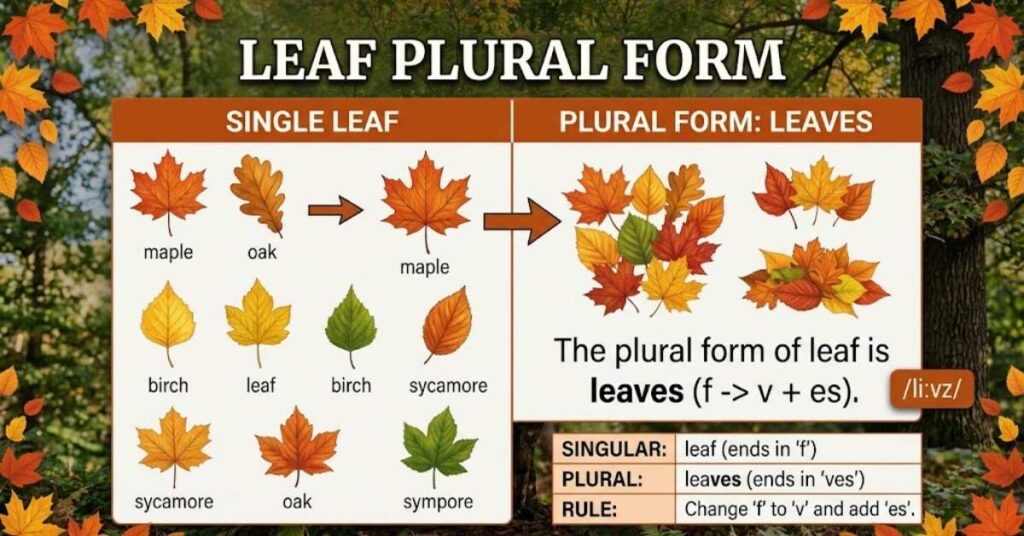
The leaf plural form is leaves. It’s an irregular plural noun, so the usual “just add s” rule doesn’t apply here.
Plenty of English nouns ending in f or fe switch to ves in the plural. Think wolf and wolves, knife and knives, shelf and shelves, half and halves, and loaf and loaves. Leaf belongs to that same family.
Not every f word plays along, though. Roof, chief, cliff, belief, and chef just add s. The pattern traces back to how Old English handled the f sound, and today you mostly learn each word by seeing it used.
Is it Leafs or Leaves: What’s the Difference?
The difference comes down to grammar and context. Leaves can be a plural noun or a verb, while leafs is a verb in everyday writing (plus that one famous team name).
Ask yourself a simple question. Are you counting plant parts, or describing an action? Your answer picks the word for you.
Short Comparison Between Leafs Vs Leaves
Here’s a leafs vs. leaves comparison table you can screenshot for study time. It covers every job each word does.
| Word | Part of speech | Meaning | Example |
| Leaves | Plural noun | More than one leaf | The leaves turned orange overnight. |
| Leaves | Verb (third-person singular) | Departs or goes away | She leaves for class at eight. |
| Leafs | Verb (third-person singular) | Flips pages, or grows leaves | He leafs through his notes. |
| Leafs | Proper noun | The Toronto Maple Leafs | The Leafs hit the ice at seven. |
Notice that leaves shows up twice. Its spelling and sound stay identical, so the sentence around it tells you which meaning you’ve got.
More Meaning of Different Words
To leaf means turning pages or flipping through a book. If you skim a stack of handouts, you’re fluttering through documents and you leaf through them.
To leave means to depart, go away, or step out of a place. Plants use the verb too. A maple leafs out in April when new foliage appears, so “leafs out” is a real phrase in gardening talk.
Leafs as a Verb and Leaves as a Verb: Present Tense Made Simple
Let’s run the verb conjugation in the present tense. For leaf, you get I leaf, you leaf, and he leafs. For leave, you get I leave, you leave, and she leaves.
Past tense splits the two even more. Someone who flipped through pages “leafed” through them, while someone who departed “left.” Writing “He leafed the room” would confuse everybody.
Try a quick swap test. If “departs” fits the sentence, use leaves. If “flips through” fits, use leafs.
Leafs or Leaves in a Sentence: Real Examples
Examples make the rule stick faster than any chart. Here are a few from everyday writing, each showing a different job.
- The autumn leaves covered the whole path to the library.
- Dad leaves for work before sunrise.
- She leafs through her textbook before every quiz.
- The old oak leafs out later than the birches.
Now try writing your own. Pick one sentence about your morning and decide if you need the noun or the verb. That small habit builds word usage confidence quickly.
Toronto Maple Leafs: Why the Spelling Looks Wrong but Isn’t
The Toronto Maple Leafs play in the National Hockey League (NHL). Their name is a proper noun, so the grammar rules for common plurals don’t apply.
Team names, brand names, and trademarks follow whatever the owners chose. Plenty of grammar fans expect “Maple Leaves,” but the club kept Leafs. The Boston Red Sox did something similar by choosing Sox over socks.
Capitalization helps you here. Write “the Leafs” with a capital L when you mean the team, and keep “leaves” lowercase when you mean foliage. Mixing those up is an easy way to confuse a hockey team name with a tree.
Leaves in Nature: Autumn Colors and Plant Life
Part of the reason people use this word so often is how much plant life depends on it. Lush forests, backyard gardens, and city parks all get their green look from foliage. Walk past any hedge in spring and you’re seeing flora at work.
Leaves look green because of chlorophyll, the pigment that helps with photosynthesis. When days shorten, many trees stop making it. That’s when changing leaf colors show up, and the other pigments finally get their moment.
These seasonal changes are why “autumn leaves” is such a popular phrase in poems, captions, and school essays. Writing it correctly matters, since a stray “leafs” in the middle of a pretty sentence ruins the mood fast. Picture a student describing a green structure on a tree in a science report. One wrong plural, and the whole paragraph looks less careful.
Idioms and Expressions Involving “Leaves”
English loves figurative language, and leaves show up in a lot of idiomatic expressions. Turn over a new leaf means to start fresh with better habits. After a rough semester, you might turn over a new leaf and plan your study schedule.
Take a leaf out of someone’s book means to copy a good habit or approach. For example, “Take a leaf out of Maya’s book and start your essay early.” Two other sayings use the verb, not the plant. Leave no stone unturned means searching every possibility, and leave someone in the dust means outpacing them.
A leaf in the wind describes someone drifting without direction. Like two leaves on a tree and fall from grace like an autumn leaf are more poetic images than fixed sayings, so you won’t always find them in dictionaries. They still work well for metaphorical meanings when you want a vivid line.
Memory Tricks and Common Mistakes
Try this trick: if you can count them, write leaves. One leaf keeps the F, and many leaves take the V. Another option is to chant the whole group together: knives, wolves, shelves, leaves.
Watch for a few repeat offenders. Writers type “leafs” as a plural, add an extra e to get “leafes,” or write “a leaves” with an article that expects a singular. Apostrophes cause trouble too. The leaf’s color is one leaf, while the leaves’ colors belong to many.
Before you hit send, search your draft for “leafs” and check each one. If the word counts plants, change it. That two-minute pass protects your writing accuracy every time.
Other Commonly Confused Spellings Worth Knowing
If this pair tripped you up, you’re in good company. Commonly confused words sneak into every draft, even from seasoned writers.
- Caliber vs. calibre: the first is American English spelling, the second is British English spelling. They’re the same word.
- Training or trainning: training is correct, and trainning is a misspelling.
- Hussle vs. hustle: hustle is the standard spelling, while “Hussle” appears mainly in stylized names.
The pattern behind most of these is simple. Check whether the difference is regional or a plain error, then confirm it in a dictionary. That one habit clears up most spelling variations fast.
Why Getting It Right Matters for Students and Writers
Clear communication depends on small details. A wrong plural can pull your reader out of the story and make them doubt the rest of your page.
For English language learners, this pair is a great case study. It shows how irregular plural nouns, verb forms, and context work together. Learn this one, and the next confusing pair feels less scary.
Teachers and editors notice these things too. Good writing precision doesn’t make you stiff. It lets your ideas land without friction.
Conclusion
So, is it leafs or leaves? For more than one leaf on a plant, always write leaves. Use leafs only as a verb for flipping pages or growing foliage, and in the name of the Toronto Maple Leafs.Keep the leaf plural form in your pocket, along with the wolves, knives, and shelves family. Add the swap test for verbs, and you’ll rarely second guess yourself again.
Which part tripped you up the most? Drop a comment below, or share this guide with a classmate who’s still writing “leafs” on every essay.
FAQs
Is It Leafs Or Leaves?
Use leaves when you mean more than one leaf. Use leafs only as a verb, like “He leafs through the book,” or when writing the Toronto Maple Leafs.
Which Is Correct Leaves Or Leafs?
Leaves is correct for the plural noun. Leafs is correct only in the verb sense and in the hockey team name.
What Is the Plural of Leaf?
The plural of leaf is leaves. It follows the same f to ves pattern as wolf and knife.
Can You Use Leafs as a Verb?
Yes. “She leafs through the pages” and “The maple leafs out in spring” are both correct. The past tense is leafed.
Is It Maple Leafs or Maple Leaves?
For the hockey team, it’s Maple Leafs. For actual foliage from a maple tree, write maple leaves.
