

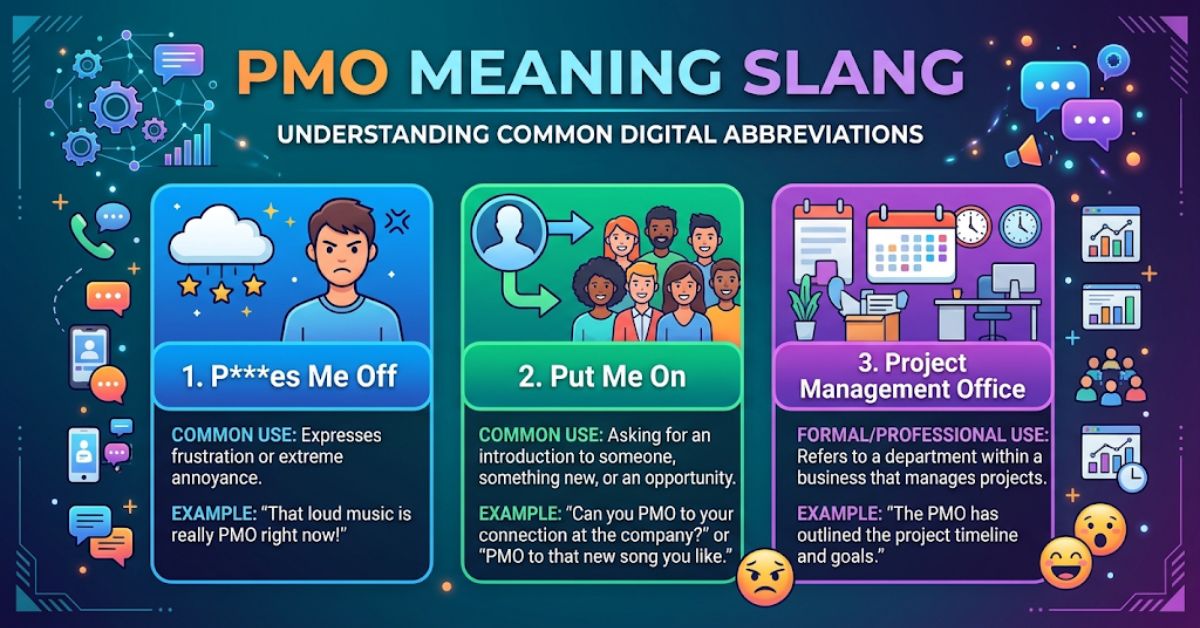
Have you ever seen someone text PMO and paused because you had no idea what it meant? You’re not alone. Internet slang changes quickly and some abbreviations carry more than one meaning. PMO is a perfect example. It usually means Put Me On when someone wants recommendations or an introduction. However, it can also mean Pisses Me Off when someone feels irritated. So, understanding the pmo meaning slang requires more than knowing its full form. You also need to pay attention to the conversation.
You might spot PMO in TikTok comments, Instagram DMs, Snapchat messages, or everyday chats with friends. Someone might use it to ask for a new playlist, a movie suggestion, or a useful tip. Another person might use it to express frustration. Knowing the difference helps you understand the message and reply naturally. Let’s break down both meanings with simple explanations and real-life examples.
What Does PMO Mean in Text?
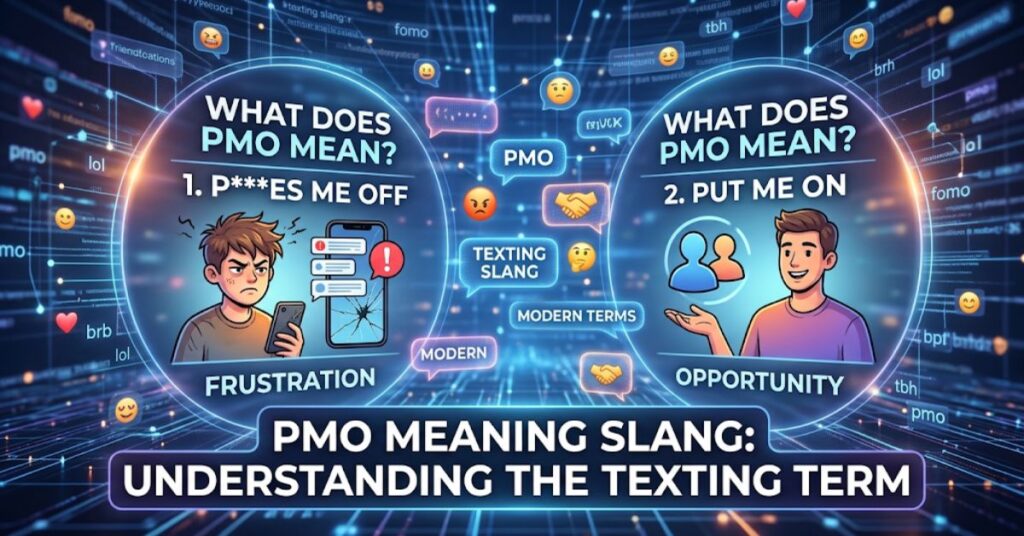
Have you ever received a message containing PMO and wondered what the sender meant? This abbreviation appears in text messages, social media comments, and everyday online conversations. However, its meaning can change depending on the situation.
PMO usually stands for Put Me On in text slang. People use it when they want recommendations, introductions, or access to something interesting. For example, someone might ask for new music, good restaurants, or clothing brands.
However, PMO has another common meaning: Pisses Me Off. People use this version to express frustration or annoyance. The surrounding conversation usually reveals the intended meaning.
Quick Answer (Featured Snippet Style)
PMO usually means Put Me On in texting and social media. People use it to ask for recommendations, introductions, or something useful. However, PMO can also mean Pisses Me Off when someone expresses frustration. The correct meaning depends on the conversation’s context.
Simple Meaning of PMO
The simple meaning of PMO is asking someone to recommend or introduce you to something. It’s a shortcut for requesting suggestions without typing a complete sentence.
When someone says Put Me On, they usually want you to share something worth knowing. It could be a new artist, restaurant, TV show, or exciting opportunity.
For example:
Friend: Your playlist sounds amazing!
You: Thanks! PMO to some new artists too.
Here, PMO means recommend something interesting.
People also use this abbreviation when they want an introduction to someone. For instance, a friend might ask you to connect them with a person who offers career opportunities.
Another Meaning of PMO
Besides Put Me On, PMO can mean Pisses Me Off. This interpretation expresses irritation, anger, or frustration about something.
People commonly use it when discussing annoying situations, frustrating habits, or everyday problems. Unlike the friendly tone of Put Me On, this version carries a negative feeling.
For example:
Friend: The Wi-Fi stopped working again.
You: Seriously, slow internet PMO!
Here, PMO means slow internet really annoys you.
Remember that Pisses Me Off contains mild profanity. It’s common in casual conversations but might sound inappropriate in formal settings.
Where Is PMO Used?
PMO appears across different online platforms and everyday conversations. Younger internet users often use it because short abbreviations make chatting quicker.
You’ll find this PMO slang in social media comments, private messages, gaming communities, and music discussions. Friends also use it when sharing recommendations or complaining about something.
Common places where people use PMO include:
- Social media platforms and comment sections.
- Private text messages and group chats.
- Gaming and entertainment communities.
- Music and fashion discussions.
- Online forums and meme culture.
The meaning doesn’t necessarily change between platforms. However, the conversation usually determines whether someone means Put Me On or Pisses Me Off.
Social Media
Social media has helped popularize PMO among Gen Z and younger Millennials. People frequently use it when sharing recommendations or asking others about interesting content.
You’ll commonly encounter PMO on:
- Instagram and Instagram Reels.
- TikTok comments and videos.
- Snapchat stories and direct messages.
- X (formerly Twitter).
- Threads and Facebook.
- Reddit discussions.
For example:
Comment: That skincare routine looks amazing. PMO to those products!
Here, the person wants recommendations.
On TikTok, someone might comment PMO to your favorite underground rappers. They’re asking the creator to suggest new music.
Text Messages
Text messages are another common place to encounter PMO. Friends often use this abbreviation when chatting about entertainment, shopping, food, or everyday interests.
Instead of typing a lengthy question, they simply write PMO. The other person can understand the request from the surrounding conversation.
For example:
Friend: I need something interesting to watch tonight.
You: PMO to some good horror movies.
In this conversation, PMO means recommend something worth watching.
You might also see it in group chats when someone wants restaurant suggestions, travel ideas, or useful apps. Its casual style makes it suitable for everyday conversations.
Gaming Communities
Gaming communities use PMO when players want recommendations, helpful resources, or advice from experienced gamers.
Someone might ask about multiplayer games, gaming equipment, or better settings. Others may request strategies that improve their performance.
For example:
Player 1: I’m getting bored with my current games.
Player 2: PMO to some fun multiplayer games.
Here, PMO means recommend some games.
Gamers also use the abbreviation when discussing:
- Gaming settings and configurations.
- Useful equipment and accessories.
- New multiplayer games.
- Playing strategies and techniques.
- Interesting gaming communities.
The phrase helps players exchange useful suggestions without lengthy explanations.
Music Discussions
Music discussions are among the most natural places to use PMO. People often ask friends to recommend artists, playlists, and songs they haven’t heard before.
You might see someone requesting underground rappers, new rock bands, or fresh music recommendations.
For example:
Friend: I’ve been listening to the same playlist all week.
You: PMO to some underground rappers!
This means you want someone to recommend underground rap artists.
Music lovers also use PMO when discussing different genres, albums, and emerging musicians. It’s a friendly way to discover something new and exchange musical interests.
Fashion Communities
Fashion communities use PMO when people want clothing recommendations or inspiration. Someone might admire another person’s outfit and ask where they purchased particular items.
For example:
Friend: Those sneakers look really good!
You: Thanks! PMO to your favorite sneaker brands too.
Here, both people want fashion recommendations.
PMO can appear in conversations about:
- Clothing brands and sneaker brands.
- Everyday outfits and styling ideas.
- Skincare products and beauty routines.
- Affordable shopping recommendations.
- Fashion accessories and trends.
It helps people share useful shopping ideas without making the conversation feel formal.
Why Do People Use PMO?
PMO has become popular because it makes online communication quicker and more relaxed. Instead of writing complete questions, people use a short abbreviation that carries the same basic message.
This style fits modern texting habits, especially among younger internet users. Social media also encourages quick interactions through comments, reactions, and short messages.
People generally use PMO for four main reasons:
- It saves time while typing.
- It creates a relaxed conversational tone.
- It follows popular internet slang trends.
- It encourages people to exchange recommendations.
However, its popularity doesn’t mean everyone understands it. Context and audience still matter when using unfamiliar abbreviations.
It’s Short
One major reason people use PMO is its simplicity. Three letters can replace a longer request for recommendations or suggestions.
For example, instead of writing:
Can you recommend some good movies?
Someone might simply type:
PMO to some good movies.
This shorter version communicates the same basic idea in casual conversations.
Short texting abbreviations also make messages easier to type quickly. That’s especially useful when chatting with friends or commenting on social media posts.
However, shorter doesn’t always mean clearer. If someone doesn’t recognize PMO slang, a complete sentence might work better.
It Sounds Casual
PMO sounds relaxed and friendly in everyday conversations. It doesn’t carry the formal tone of phrases like Could you recommend or Would you introduce me to someone?
People often use it when chatting with friends or interacting with online communities.
For example:
Friend: I need a new Netflix series.
You: PMO to something worth binge-watching.
This sounds natural between people who understand the abbreviation.
The phrase also helps conversations feel less serious. However, it’s best suited to informal language rather than professional communication.
It’s Trendy
Internet slang changes quickly, and PMO has become part of modern social media language. Gen Z and younger Millennials frequently encounter abbreviations through videos, comments, and online conversations.
TikTok, Instagram Reels, and meme culture help spread these expressions. Someone might see PMO in a popular comment and start using it with friends.
Other texting abbreviations include HMU, WYA, IMO, TBH, and FWIW. Each has its own meaning and purpose.
Although PMO feels trendy, you don’t need to use it everywhere. Choose language that suits your audience and the conversation.
It Starts Conversations
PMO doesn’t just shorten messages. It also encourages people to share recommendations and experiences.
When someone asks you to put them on, they’re inviting you to contribute something useful. You might recommend a restaurant, introduce an artist, or share an interesting opportunity.
For example:
Friend: I want to start watching anime.
You: PMO to your favorite series!
This creates an easy opportunity to exchange interests.
Unlike a simple reaction, PMO encourages people to continue talking. That’s one reason it works well in social media comments and group chats.
Real-Life Examples of PMO in Text
Examples make PMO easier to understand because its meaning often depends on the topic. The same abbreviation can express a request or frustration in different conversations.
Most examples involve recommendations, introductions, or complaints. Once you recognize these patterns, interpreting PMO becomes much easier.
Here are eight everyday situations where people might use it.
Example 1: Music
Conversation:
Friend: I’ve run out of good songs to listen to.
You: PMO to some new artists.
Meaning: Recommend some new musicians or songs.
People often use PMO when discussing playlists, underground rappers, and new rock bands. It’s especially common among friends who enjoy sharing music.
Example 2: Food
Conversation:
Friend: That burger looks incredible!
You: PMO to the restaurant.
Meaning: Tell me where you bought that burger.
Someone might also use PMO when asking about pizza places, local restaurants, or interesting food spots.
It’s a simple way to request recommendations without sounding demanding.
Example 3: Movies
Conversation:
Friend: I want to watch something interesting tonight.
You: PMO to some good horror movies.
Meaning: Recommend some horror films.
People also use PMO when looking for thrillers, comedies, action movies, or other movie suggestions.
For example, you might recommend Inception or The Prestige if someone enjoys clever stories and unexpected twists.
Example 4: TV Shows
Conversation:
Friend: I need a new series for the weekend.
You: PMO to something on Netflix.
Meaning: Suggest a good TV show.
This usage often appears when people want recommendations for binge-watching. Someone might suggest a popular drama, comedy, documentary, or mystery series.
PMO makes the request sound relaxed and conversational.
Example 5: Fashion
Conversation:
Friend: Your outfit looks amazing today.
You: Thanks! PMO to some good clothing brands.
Meaning: Recommend some clothing brands.
Fashion lovers use PMO when discussing outfits, sneakers, skincare products, and shopping ideas.
It can also help people exchange affordable fashion recommendations and styling inspiration.
Example 6: Career
Conversation:
Friend: I’m looking for remote work opportunities.
You: PMO to some companies hiring.
Meaning: Share useful job opportunities or introduce me to potential employers.
People might use PMO when discussing remote jobs, internships, professional connections, or career opportunities.
However, the abbreviation works best in casual conversations rather than formal job applications.
Example 7: Fitness
Conversation:
Friend: I want to become more consistent with exercise.
You: PMO to some good workout apps.
Meaning: Recommend useful fitness applications.
People also use PMO when discussing gym routines, workout equipment, exercise programs, and fitness advice.
It’s an easy way to ask friends for practical suggestions.
Example 8: Frustration Meaning
Conversation:
Friend: My phone keeps freezing whenever I open an app.
You: That PMO too!
Meaning: That annoys me too!
In this example, PMO means Pisses Me Off rather than Put Me On.
People use this interpretation when discussing frustrating situations. It can express irritation about slow internet, annoying habits, or everyday problems.
PMO Meaning in Different Situations
The meaning of PMO becomes easier to recognize when you consider the conversation’s subject. People generally use Put Me On when requesting recommendations or introductions.
However, they use Pisses Me Off when expressing annoyance. A single abbreviation can therefore communicate two very different feelings.
Understanding the topic helps you avoid common misunderstandings. Here’s how PMO works in different situations.
When Talking About Music
When someone discusses music, PMO usually means Put Me On. They’re asking another person to recommend songs, artists, or playlists.
For example:
Friend: I’ve been listening to the same rapper lately.
You: PMO to some new underground rappers.
The request encourages music recommendations.
Someone might also ask for new rock bands, hip-hop albums, or artists from unfamiliar genres. Music communities use this expression to exchange discoveries and expand their playlists.
When Talking About Food
In food conversations, PMO usually means asking for restaurant or meal recommendations.
For example:
Friend: That pizza looks delicious.
You: PMO to the place where you ordered it.
Here, the person wants the restaurant’s name or location.
You might also encounter PMO when discussing burger spots, local food, cafes, or new restaurants. The phrase helps people share useful suggestions without lengthy questions.
When Talking About Clothes
When someone compliments your clothes, they might use PMO to request fashion recommendations.
For example:
Friend: Those sneakers look amazing.
You: PMO to your favorite sneaker brands too.
In this situation, PMO means Put Me On.
People use it when discussing clothing brands, outfits, accessories, and skincare products. It’s particularly common in casual fashion communities where people exchange shopping ideas.
When Talking About Jobs
PMO can also appear in conversations about employment and career opportunities.
For example:
Friend: I’m searching for remote jobs.
You: PMO to any companies hiring.
Here, the speaker wants useful information about potential opportunities.
The abbreviation might also involve internships, professional introductions, or career advice. However, remember that PMO sounds informal. Clearer language works better when contacting recruiters or employers.
When Talking About Problems
When someone complains about an annoying situation, PMO usually means Pisses Me Off.
For example:
Friend: People keep interrupting me during conversations.
You: That PMO too.
Here, the speaker expresses frustration and agreement.
Other examples include slow internet, noisy neighbors, broken devices, and frustrating daily habits.
Pay attention to the emotional tone. If someone describes a problem rather than requesting a recommendation, Pisses Me Off is probably the intended meaning.
PMO vs Similar Text Slang
PMO belongs to a larger group of internet slang and texting abbreviations. However, similar expressions don’t necessarily share the same meaning.
Understanding these differences helps you communicate more naturally. It also prevents confusion when someone uses several abbreviations in one conversation.
Here are some common expressions compared with PMO.
| Slang | Full Form | Meaning |
| PMO | Put Me On | Recommend or introduce me to something |
| HMU | Hit Me Up | Contact me |
| WYA | Where You At? | Asking about someone’s location |
| IMO | In My Opinion | Sharing a personal opinion |
| TBH | To Be Honest | Introducing an honest statement |
| FWIW | For What It’s Worth | Offering an opinion or perspective |
| SMT | Suck My Teeth / other context-dependent meanings | Expressing annoyance or a reaction |
| PTM | Context-dependent abbreviation | Requires the surrounding conversation |
| TTM | Talk to Me | Asking someone to communicate |
For example, PMO to some good songs requests recommendations. HMU later asks someone to make contact.
Although these expressions belong to informal communication, each serves a different purpose. Always consider the surrounding message before interpreting unfamiliar slang.
How to Know Which PMO Meaning Someone Is Using
Seeing PMO without context can feel confusing. Fortunately, you don’t need to guess every time someone uses it.
The easiest method is to examine the complete sentence. Look at the topic, the speaker’s tone, and what they’re asking you to do.
Ask yourself whether the person wants a recommendation or expresses frustration. These clues usually reveal the intended meaning.
For example:
- A request for music usually suggests Put Me On.
- A question about restaurants usually suggests Put Me On.
- A complaint about annoying behavior suggests Pisses Me Off.
- A frustrated reaction often points toward Pisses Me Off.
If the message still seems unclear, asking for clarification is perfectly normal.
If Someone Is Asking for Something…
When someone requests recommendations, introductions, or useful information, PMO probably means Put Me On.
Look for phrases that mention discovering something new or finding a particular item.
For example:
Friend: I need some new anime recommendations.
You: PMO to your favorite series.
The request clearly involves suggestions.
Other clues include conversations about:
- Music recommendations and playlists.
- Movie suggestions and TV shows.
- Restaurants and food.
- Clothing and sneaker brands.
- Games and useful applications.
- Remote jobs and career opportunities.
When the conversation focuses on finding something interesting, Put Me On is usually the right interpretation.
If Someone Is Complaining…
When someone describes an irritating experience, PMO probably means Pisses Me Off.
This version usually appears in negative statements or emotional reactions.
For example:
Friend: People who cancel plans at the last minute PMO.
You: Same! That’s really frustrating.
The speaker isn’t asking for recommendations. They’re expressing annoyance.
Other clues include complaints about slow internet, rude behavior, unnecessary arguments, or broken technology.
The emotional tone matters here. If someone sounds irritated rather than curious, Pisses Me Off is probably what they mean.
When Should You Use PMO?
PMO works best when you’re chatting with friends or participating in relaxed online conversations. Use it when you want someone to recommend something or introduce you to something interesting.
It’s especially useful when discussing shared interests. For example, you might ask someone to recommend a playlist, suggest restaurants, or share multiplayer games.
Good situations for using PMO include:
- Asking friends for music recommendations.
- Finding movies or TV shows.
- Getting restaurant and food suggestions.
- Discovering clothing and sneaker brands.
- Asking about useful apps or books.
- Finding travel ideas.
- Discussing gaming equipment and strategies.
- Learning about career opportunities.
You can also use PMO when replying to social media posts. Just make sure the other person understands the abbreviation.
When You Should Avoid Using PMO
Although PMO works well in casual conversations, it doesn’t suit every situation. Some people might not recognize the abbreviation, especially older users or those unfamiliar with social media slang.
Avoid using it in formal communication where clarity and professionalism matter. This includes business emails, school assignments, professional reports, and formal job applications.
It’s also better to avoid PMO in academic writing, official documents, and important business meetings.
Instead, use clearer alternatives:
- Could you recommend a suitable product?
- Can you suggest some useful resources?
- Would you introduce me to someone in your industry?
These phrases sound more professional and leave little room for confusion.
Common Misunderstandings About PMO
PMO can confuse people because it has multiple meanings. Someone unfamiliar with internet slang might interpret it differently from regular social media users.
The abbreviation also appears in different situations. That’s why understanding its context matters more than memorizing one definition.
Here are some common misunderstandings worth knowing.
Myth 1: PMO Always Means One Thing
This isn’t true. PMO commonly means Put Me On or Pisses Me Off in informal conversations.
The intended meaning depends on the sentence and situation.
For example, PMO to some good movies requests recommendations. Meanwhile, Loud chewing PMO expresses annoyance.
Always read the complete message before deciding what someone means. A few surrounding words can completely change the interpretation.
Myth 2: PMO Is Offensive
PMO isn’t automatically offensive. Its Put Me On meaning is generally friendly and harmless.
However, Pisses Me Off contains mild profanity. It expresses irritation and might sound inappropriate in certain conversations.
For example, asking a friend to PMO to new music is perfectly casual. Using the frustration-related meaning in a professional report would be unsuitable.
The intended meaning and audience determine whether PMO sounds appropriate.
Myth 3: Everyone Knows PMO
Not everyone understands modern internet slang. Younger users might recognize PMO immediately while older users could find it confusing.
People also have different experiences with texting abbreviations and social media platforms.
For example, someone who regularly uses TikTok might recognize PMO from comments. Another person who rarely uses social media might not understand it.
If you’re unsure, use complete words or explain the abbreviation.
Myth 4: PMO Is Only Used on TikTok
PMO isn’t limited to TikTok. Although the platform helps spread trendy slang, people use the abbreviation across several online communities.
You might encounter it on:
- Instagram and Instagram Reels.
- Snapchat and Facebook.
- X and Threads.
- Discord and Reddit.
- WhatsApp and regular text messages.
Its use also extends to gaming, music, and fashion communities. The platform might change, but the basic meanings remain similar.
How to Reply When Someone Says PMO
Knowing how to reply to PMO makes online conversations easier. However, your response should match the meaning behind the abbreviation.
If someone wants recommendations, share something useful. You could suggest a movie, introduce an artist, or recommend a restaurant.
For example:
Them: PMO to some good movies.
You: Try Inception or The Prestige. Both are worth watching.
Other possible replies include:
- Try this playlist. You’ll love it.
- Check out this restaurant downtown.
- You should listen to this artist.
- Here’s a useful fitness app.
However, if PMO means Pisses Me Off, respond to the person’s frustration instead.
Them: People who interrupt me PMO.
You: Same! It’s really annoying.
If you can’t understand the intended meaning, simply ask: Do you mean Put Me On?
Why PMO Became So Popular
PMO became popular because modern online conversations often favor short and direct expressions. People want to communicate quickly without typing long sentences every time.
Instead of asking someone to recommend good music, they can simply write PMO to some good music.
Social media also plays an important role. TikTok videos, Instagram comments, and meme culture help introduce slang to wider audiences.
Gen Z and younger Millennials often encounter these expressions through online communities. Friends then carry the same language into private messages and everyday conversations.
PMO also fits naturally into different interests. People use it when discussing music, food, fashion, gaming, and entertainment.
However, popularity doesn’t make every abbreviation suitable for every audience. Clear communication still matters more than following trends.
Pro Tips for Using PMO Correctly
Using PMO isn’t complicated once you understand its meanings. However, a few simple habits can help you avoid awkward conversations and misunderstandings.
Think about the person you’re messaging and the subject you’re discussing. A little attention to context makes internet slang much easier to use.
Keep these practical tips in mind.
Pay Attention to Context.
Context is the easiest way to understand PMO. Look at the surrounding words before deciding which meaning fits.
If someone requests recommendations, Put Me On probably makes sense. If they’re complaining about something, Pisses Me Off is more likely.
For example, PMO to good restaurants is a request. Meanwhile, Traffic PMO expresses frustration.
Use It Casually.
PMO belongs to informal language. It works naturally in conversations with friends and people who understand modern text slang.
You can use it when discussing music, movies, food, gaming, or fashion.
However, avoid forcing it into serious conversations. A natural message always sounds better than unnecessary slang.
Don’t Force Slang.
Not every conversation needs an abbreviation. Sometimes, writing a complete sentence is simpler and clearer.
For example, Could you recommend a good restaurant? works perfectly well without PMO.
Use slang when it fits your usual communication style. You don’t need to follow every internet trend to sound friendly.
Ask if You’re Unsure.
If someone sends PMO and you can’t understand the intended meaning, asking for clarification is perfectly fine.
For example:
You: Do you mean Put Me On?
Friend: Yeah, I’m asking for music recommendations.
A quick question can prevent unnecessary confusion. It’s better than responding with the wrong interpretation.
Keep Your Audience in Mind.
Before using PMO, consider whether the other person understands internet slang.
Your close friends might recognize it immediately. However, older users, professional contacts, or people unfamiliar with social media might need a clearer explanation.
Choose your wording according to the situation. Casual abbreviations work best when everyone understands their meaning.
Final Thoughts
Understanding the pmo meaning slang can make online chats much easier. PMO usually means Put Me On when someone asks for recommendations or new ideas. It can also mean Pisses Me Off when someone feels annoyed. The pmo meaning slang changes with the conversation. So, always read the full message before deciding what someone means. This small step can help you avoid confusion and reply with confidence.
You may see PMO on TikTok, Instagram, Snapchat, Discord, and text messages. Friends often use it to discuss music, movies, fashion, or everyday problems. Now that you know the pmo meaning slang, you can understand both uses more clearly. Remember to keep it casual and avoid using it in formal settings. When you’re unsure, ask the sender what they mean. A simple question can clear up any misunderstanding.
Frequently Asked Questions (FAQ)
What does PMO mean in texting?
PMO usually means Put Me On in texting. People use it to ask for recommendations, suggestions, or introductions. It can also mean Pisses Me Off when someone expresses anger or frustration. The conversation helps you understand which meaning fits.
Does PMO always mean Put Me On?
No, PMO doesn’t always mean Put Me On. It can also stand for Pisses Me Off. For example, someone might say PMO to request a new song or complain about an annoying situation. Always check the surrounding message.
Is PMO rude?
PMO isn’t always rude. When it means Put Me On, it usually sounds friendly and casual. However, Pisses Me Off expresses frustration and includes mild profanity. Consider your audience before using it.
Can I use PMO in professional conversations?
It’s better to avoid PMO in professional conversations. The abbreviation can confuse people who don’t know internet slang. Instead, use clear phrases like Could you recommend something? or Can you suggest a useful option? These sound more appropriate in work emails and business discussions.
