

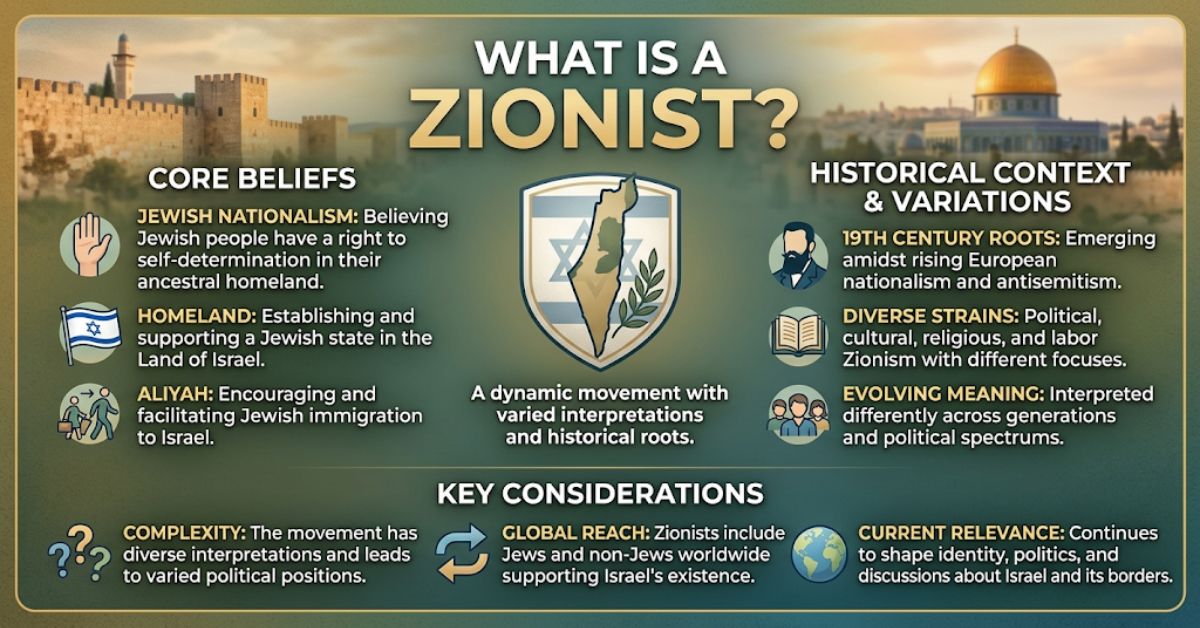
One word can carry centuries of history, identity, and political debate. That word is Zionist. You may have seen it in news stories, social media posts, or discussions about Israel and Palestine. But what does it actually mean? Many people use the term without fully understanding its history or purpose. A Zionist generally supports Jewish national self-determination in the historic Land of Israel. This idea grew into a modern political movement during the late 19th century.
So, what is a zionist? Is it a religious belief, a political identity, or support for Israel? The answer isn’t as simple as many people think. Zionists have different beliefs and political views. Some support Israel’s existence while criticizing its government policies. Others have different opinions about Palestine and peace. Understanding these differences makes the term easier to understand. Let’s look at its meaning, history, beliefs, and common misconceptions.
What Does Zionist Mean?
A Zionist is someone who supports Zionism, a movement centered on Jewish national self-determination in the historic Land of Israel. In simple terms, Zionists generally support the idea that Jewish people should have a national home in their historic homeland. Today, many Zionists also support Israel’s existence as a Jewish state.
So, what is a zionist? The answer depends partly on the historical and political context. Zionists come from different religious, cultural, and political backgrounds. They don’t all share the same views about Israeli government policies or the Israeli-Palestinian conflict.
The term is connected to Zion, a biblical name associated with Jerusalem.
A Zionist may support:
- Jewish national self-determination.
- Israel’s existence as a Jewish homeland.
- The protection of Jewish history and identity.
For example:
Person A: “Does being a Zionist mean supporting every Israeli decision?”
Person B: “No. Zionists can disagree strongly about government policies.”
What Is Zionism?
Zionism is a Jewish national movement that developed in modern Europe during the late 19th century. Its central goal was Jewish national self-determination in the historic Land of Israel. The movement grew partly in response to antisemitism, discrimination, persecution, and violent pogroms across Europe.
Zionism also reflected a desire to protect Jewish survival, culture, and identity. Supporters believed Jewish communities needed a secure national home. Different groups disagreed about how to achieve that goal.
Zionism developed into several political and cultural movements. Some emphasized a Jewish state while others focused on language, education, or community life.
Its history includes:
- Jewish nationalism and European nationalism.
- Jewish immigration to Palestine.
- Efforts to establish agricultural settlements.
- Debates about Jewish and Palestinian national aspirations.
In simple words: Zionism is a movement supporting Jewish national self-determination.
Zionist Meaning in Simple Words
The Zionist meaning is easier to understand when you connect it to the idea of a homeland. Zionism supports the belief that Jewish people have a right to national self-determination in their historic homeland. For many supporters, this means maintaining Israel as a Jewish state.
However, Zionism isn’t one single political position. Some Zionists are religious while others are secular. Some support a two-state solution and Palestinian statehood. Others hold different views about borders, security, and the future of the region.
Think of it as a broad national movement rather than a group with identical beliefs.
Here are a few simple points:
- Zion: A biblical term associated with Jerusalem.
- Zionism: A movement for Jewish national self-determination.
- Zionist: A person who supports Zionism.
- Jewish homeland: A central idea in Zionist history.
Conversation example:
Friend: “What does Zionist mean?”
You: “It usually describes someone who supports Jewish national self-determination in the historic Land of Israel.”
Zionist vs. Zionism: What Is the Difference?
The difference between Zionist and Zionism is simple. Zionism is the movement or ideology. A Zionist is a person who supports it. These terms are closely related, but they don’t mean exactly the same thing.
Zionism developed as a national movement in the late 19th century. It focused on Jewish self-determination and the establishment of a Jewish national home. A Zionist may support these goals for religious, historical, cultural, or political reasons.
Here’s a quick comparison:
| Term | Meaning |
| Zion | A biblical name associated with Jerusalem |
| Zionism | A movement supporting Jewish national self-determination |
| Zionist | A person who supports Zionism |
| Jewish homeland | The national home central to Zionist thought |
For example:
- “Zionism influenced modern Jewish political history.”
- “She describes herself as a Zionist.”
Remember, an ideology and a person who supports it are different things.
Where Did Zionism Come From?
Zionism emerged as an organized modern political movement in Europe during the late 19th century. However, its roots reach much further into Jewish history. Jewish religious texts, prayers, and historical memory contain a longstanding connection to Zion and Jerusalem. Jewish communities also maintained cultural and religious ties to the region across many centuries.
Modern Zionism developed amid European nationalism, rising antisemitism, discrimination, and violent pogroms. Many Jewish people faced persecution and limited opportunities for safety or equality. Some believed national self-determination offered a path toward security and survival.
Important developments included:
- Jewish nationalist ideas in Europe.
- The growth of organized Jewish communities and movements.
- Jewish immigration to Ottoman Palestine.
- Early agricultural settlements.
- The rise of political and cultural Zionism.
The movement later grew during the British Mandate period.
Theodor Herzl and Political Zionism
Theodor Herzl played a major role in organizing modern political Zionism. He was a Jewish journalist and writer who argued that Jewish people needed a secure national home. In 1896, he published Der Judenstaat (The Jewish State), a work that helped shape the movement’s political direction.
Herzl organized the First Zionist Congress in 1897 in Basel, Switzerland. The meeting brought supporters together and helped establish the World Zionist Organization. It gave the growing movement a more organized political structure.
However, Herzl didn’t create every form of Zionist thought. Earlier thinkers also influenced the movement.
Key details about Herzl include:
- He promoted Jewish national self-determination.
- He supported organized political action.
- He helped build international support for Zionism.
- His work influenced later Jewish political movements.
Herzl became one of the best-known figures in Zionist history.
The Different Types of Zionism
Zionism includes several movements with different ideas about Jewish identity, culture, religion, and political goals. Although they share a connection to Jewish national self-determination, they don’t follow one identical approach.
Some important types include:
- Political Zionism: Focuses on creating and maintaining a Jewish national home through political action.
- Cultural Zionism: Emphasizes Jewish culture, education, and the revival of Hebrew.
- Labor Zionism: Connects Jewish national development with workers’ rights and social equality.
- Religious Zionism: Combines Jewish religious beliefs with support for Jewish national life in the historic homeland.
- Revisionist Zionism: Historically emphasized a more assertive approach to Jewish statehood and territorial claims.
- Secular Zionism: Supports Zionism without requiring religious belief.
- Socialist Zionism: Links national goals with socialist principles.
- Liberal Zionism: Emphasizes democratic values and individual rights.
These categories can overlap. Not every Zionist fits neatly into one group.
What Do Zionists Believe?
Zionist beliefs vary because Zionism is a broad national movement, not a single political party or religious organization. Most Zionists support Jewish national self-determination and believe Jewish people should have a national home in their historic homeland. Many also support Israel’s continued existence as a Jewish state.
However, Zionists can disagree about important political questions. Their views may differ on Palestinian statehood, borders, Israeli settlements, occupation, and security policy. They may also disagree strongly with Israeli government policies.
Common themes in Zionist thought include:
- Protecting Jewish identity, culture, and history.
- Supporting Jewish national self-determination.
- Maintaining a connection to Jerusalem and the historic homeland.
- Promoting Jewish safety and survival.
- Supporting Israel’s existence, though views on its future vary.
Conversation example:
Person A: “Do all Zionists agree about Palestine?”
Person B: “No. They hold different views about peace, borders, and Palestinian rights.”
Are Zionists Jewish?
Many Zionists are Jewish, but not every Zionist is Jewish. Some non-Jewish people support Zionism because they believe Jewish people have a right to national self-determination. This means the terms Zionist and Jewish don’t describe the same identity.
It’s also incorrect to assume that all Jewish people are Zionists. Jewish communities include Zionists, non-Zionists, and anti-Zionists. Their views can differ for religious, historical, cultural, and political reasons.
Keep these distinctions in mind:
- Jewish: Describes a religious, ethnic, or cultural identity.
- Zionist: Describes support for Zionism.
- Israeli: Describes citizenship or national identity connected to Israel.
- Non-Zionist: Describes someone who doesn’t identify with or support Zionism.
- Anti-Zionist: Describes someone who opposes Zionism.
Therefore, being Jewish, Israeli, and Zionist are not interchangeable labels.
Zionism and Judaism Are Not the Same Thing
Zionism and Judaism are closely connected through Jewish history, but they are not the same. Judaism is a religion and a cultural tradition with thousands of years of history. Zionism is a modern national movement that supports Jewish self-determination in the historic Land of Israel.
Some Jewish people support Zionism because they see Israel as an important part of Jewish identity and safety. Others disagree with Zionism for religious, political, or personal reasons. Some non-Jewish people also support the movement.
Here are the main differences:
- Judaism: A religion, culture, and way of life.
- Zionism: A national movement focused on Jewish self-determination.
- Jewish identity: Can include religious, cultural, ethnic, and historical connections.
Conversation example:
Person A: “Are Judaism and Zionism the same?”
Person B: “No. Judaism is a religion and tradition, while Zionism is a national movement.”
Zionism and Israel
Zionism played a major role in the establishment of modern Israel. The movement supported the creation of a Jewish national home in the historic Land of Israel. During the late 19th and early 20th centuries, Jewish immigration to Palestine increased. Jewish communities also established agricultural settlements and political institutions.
The British Mandate period brought further political developments. The 1947 UN Partition Plan recommended separate Jewish and Arab states. Israel declared independence on May 14, 1948. The declaration followed decades of Zionist organizing and growing international debate.
Important connections include:
- Zionism helped shape the movement for Jewish statehood.
- Israel became a central expression of modern political Zionism.
- Jewish communities have diverse views about Israel.
- Zionists disagree about Israel’s borders and government policies.
Example: Someone may support Israel’s existence while criticizing its current leadership.
Zionism and Palestine
Zionism and Palestine are connected through the history of the land and the competing national aspirations of Jewish and Palestinian communities. Zionism sought Jewish national self-determination in the historic homeland. Palestinian Arabs also developed a national movement focused on their identity, rights, and self-determination.
These movements increasingly came into conflict during the British Mandate period. The 1947 UN Partition Plan proposed separate Jewish and Arab states. The 1948 war led to Israel’s establishment and the displacement of hundreds of thousands of Palestinians, an experience Palestinians call the Nakba.
Key issues include:
- Palestinian statehood and national self-determination.
- Israeli security and national identity.
- Refugees and displacement.
- Borders, occupation, and settlements.
- The future of Jerusalem.
Conversation example:
Person A: “Why are Zionism and Palestine often discussed together?”
Person B: “Their histories involve the same land and competing national claims.”
Why Is the Word “Zionist” Controversial?
The word “Zionist” is controversial because people understand Zionism through different historical and political experiences. For many Jews, it represents national self-determination, safety, and a connection to their historic homeland. For many Palestinians and their supporters, Zionism is associated with displacement, loss of land, and the continuing Israeli-Palestinian conflict.
The term also appears in modern political debates. Some people use it to describe supporters of Israel’s existence. Others use it critically when discussing Israeli policies or the history of Palestinian displacement.
Context matters when someone uses the word.
- It can describe a political belief or historical movement.
- It can express support for Jewish national self-determination.
- It can appear in criticism of Israeli policies.
- It can be used unfairly as an insult or stereotype.
Criticism of Zionism or Israeli government policies isn’t automatically antisemitic. However, using “Zionist” as a substitute for “Jew” or spreading anti-Jewish stereotypes is antisemitic.
Does Zionist Mean “Israeli”?
No. The words “Zionist” and “Israeli” have different meanings. A Zionist is someone who supports Zionism and Jewish national self-determination. An Israeli is someone who holds Israeli citizenship or identifies with Israel’s national community.
Many Israelis support Zionism, but not every Israeli describes themselves as a Zionist. Likewise, many Zionists live outside Israel and may never have visited the country.
Consider these differences:
- Zionist: A person who supports Zionism.
- Israeli: A person connected to Israel through citizenship or national identity.
- Jewish: A person with a Jewish religious, ethnic, or cultural identity.
Conversation example:
Friend: “Is every Zionist from Israel?”
You: “No. Zionists live in many countries, including the United States, Europe, and elsewhere.”
Does Zionist Mean Jewish?
No. A Zionist isn’t necessarily Jewish. The term describes a person’s political or national belief rather than their religion or ethnicity. Many Jewish people identify as Zionists because they support Jewish national self-determination. However, some non-Jewish people also support the movement.
Jewish people themselves hold different views. Some support Zionism, while others identify as non-Zionist or anti-Zionist. These differences can come from religious teachings, historical experiences, or political beliefs.
Remember these distinctions:
- A Jewish person may or may not support Zionism.
- A non-Jewish person can support Zionism.
- A Zionist doesn’t have to be an Israeli citizen.
- Jewish identity and political beliefs aren’t interchangeable.
Example: A Christian who supports Israel’s existence may identify as a Zionist without being Jewish.
What Is the Meaning of “Zion”?
Zion is an ancient biblical name associated with Jerusalem. In Jewish religious texts and historical memory, it became a powerful symbol of Jerusalem and the Jewish homeland. The word also appears in Jewish prayers, songs, and cultural traditions.
Over time, Zion gained meaning beyond its geographical connection. It came to represent Jewish belonging, hope, survival, and the longing to return to a historic homeland. The modern word Zionism comes from this historical and religious term.
The word can carry several meanings:
- Historical: A name connected to Jerusalem.
- Religious: A symbol found in Jewish prayers and sacred texts.
- Cultural: A representation of Jewish identity and heritage.
- Political: A central symbol behind the modern Zionist movement.
Understanding Zion helps explain why the term Zionism became important in Jewish history.
Zionist Meaning in Modern Politics
In modern politics, the word “Zionist” usually describes someone who supports Jewish national self-determination or Israel’s continued existence as a Jewish state. However, its meaning can change depending on who uses it and the situation being discussed.
Politicians, journalists, scholars, activists, and ordinary people may use the term differently. Some use it as a neutral political description. Others use it to express support or criticism of Zionism and Israeli policies.
The term also appears in debates about Palestinian statehood, Israeli settlements, occupation, and regional security.
For example:
- A person may support Israel’s existence but oppose its settlement policies.
- Someone may criticize the Israeli government without opposing Zionism.
- Another person may reject Zionism because of their political beliefs.
Conversation example:
Person A: “Is calling someone a Zionist always an insult?”
Person B: “No. It depends on the speaker, context, and intention.”
Is Zionism a Religion?
No. Zionism is not a religion. It is a national movement focused on Jewish self-determination in the historic Land of Israel. Judaism, by contrast, is a religion and cultural tradition with its own beliefs, practices, texts, and history.
Religion has influenced some forms of Zionism, especially Religious Zionism. However, many early Zionist thinkers were secular. They viewed Jewish national identity through history, culture, language, and shared heritage rather than religious belief alone.
Zionists can therefore have different religious backgrounds.
- Religious Zionists connect Jewish national life with religious beliefs.
- Secular Zionists support the movement without requiring religious faith.
- Cultural Zionists emphasize Hebrew, education, and Jewish heritage.
Example: A person can support Zionism while being secular or nonreligious.
Is Zionism the Same as Support for the Israeli Government?
No. Supporting Zionism doesn’t mean agreeing with every decision made by the Israeli government. Zionism generally concerns Jewish national self-determination and support for a Jewish national home. Government policies are separate political matters that people can support or oppose.
Zionists have different opinions about Israeli leadership, military decisions, settlements, security policies, and Palestinian rights. Some support a two-state solution, while others favor different political arrangements.
It’s useful to separate these ideas:
- Zionism: A national movement or political belief.
- Israeli government: The elected leadership and state institutions.
- Government policy: Specific laws, decisions, and actions.
- Criticism: Opposition to particular policies or political leaders.
Conversation example:
Person A: “Can someone be a Zionist and criticize Israel?”
Person B: “Yes. Supporting Israel’s existence doesn’t require supporting every government decision.”
Zionism and the Two-State Solution
The two-state solution is a proposed way to address the Israeli-Palestinian conflict. It generally involves creating an independent Palestinian state alongside Israel. Supporters believe this arrangement could recognize both peoples’ national aspirations and provide a framework for peace.
Some Zionists support the proposal because they believe it can protect Israel’s identity while recognizing Palestinian self-determination. Other Zionists oppose it or prefer different political arrangements. Palestinians also hold varied views about its feasibility and fairness.
Important issues include:
- Borders between Israel and a future Palestinian state.
- The status of Jerusalem.
- Israeli settlements in the occupied West Bank.
- Palestinian refugees and their rights.
- Security arrangements and mutual recognition.
Example: A Zionist may support Israel’s existence while also supporting an independent Palestinian state.
Common Misunderstandings About Zionist Meaning
The word “Zionist” often causes confusion because people mix it with terms such as Jewish, Israeli, and Judaism. These words have different meanings. Zionism is a national movement, while Jewish identity and Israeli citizenship describe different forms of identity and belonging.
Political disagreements also create misunderstandings. Some people assume all Zionists share the same opinions about Israel and Palestine. Others believe Zionism is a religion or that every Jewish person supports it. These assumptions overlook the movement’s diversity.
Here are five common misunderstandings and the facts behind them.
Misunderstanding 1: Every Jewish Person Is a Zionist
Not every Jewish person identifies as a Zionist. Jewish communities include people with different religious, cultural, and political beliefs. Many support Zionism because they see Jewish self-determination as important. Others reject it or prefer not to identify with the movement.
Some Jewish people oppose Zionism for religious reasons. Others disagree with its political history or its consequences for Palestinians. These views show that Jewish identity doesn’t automatically determine someone’s political beliefs.
Remember:
- Some Jewish people are Zionists.
- Some are non-Zionists.
- Some identify as anti-Zionists.
- Jewish identity includes more than one political viewpoint.
Example: Two Jewish friends can share the same religious heritage but hold different opinions about Zionism.
Misunderstanding 2: Every Zionist Is Israeli
This is incorrect because Zionism is a belief or political position, not a citizenship category. Many Zionists live outside Israel. They may support Jewish national self-determination because of historical, cultural, religious, or political reasons.
For example, a person living in the United States, Canada, or Europe may identify as a Zionist without holding Israeli citizenship. Similarly, an Israeli citizen may have different views about Zionism.
Keep the distinction clear:
- Zionist describes support for Zionism.
- Israeli describes citizenship or national identity.
- A person can be both, but the terms aren’t interchangeable.
Conversation example:
Person A: “Do Zionists have to live in Israel?”
Person B: “No. People can support Zionism while living anywhere.”
Misunderstanding 3: Zionism Is Simply Another Word for Judaism
Zionism and Judaism are related through Jewish history, but they describe different things. Judaism is a religion and cultural tradition. Zionism is a modern national movement that supports Jewish self-determination in the historic Land of Israel.
Some Zionists connect their beliefs with Jewish religious teachings. Others approach Zionism from a secular or cultural perspective. Likewise, Jewish people can have different political opinions about the movement.
The key differences are:
- Judaism includes religious beliefs, traditions, and practices.
- Zionism focuses on Jewish national self-determination.
- A person can be Jewish without being Zionist.
- A non-Jewish person can support Zionism.
Understanding this difference helps prevent confusion in political and historical discussions.
Misunderstanding 4: Every Zionist Supports Every Israeli Government Policy
Supporting Zionism doesn’t mean agreeing with every Israeli government decision. Zionists have different political opinions and can strongly disagree about leadership, security, settlements, and relations with Palestinians.
Some support the Israeli government’s actions in certain situations. Others criticize its policies and demand political changes. Many believe Israel’s existence and its government’s decisions should be discussed separately.
For example:
- A Zionist may oppose Israeli settlements.
- Another may support a two-state solution.
- Someone else may criticize military or security policies.
- Zionists can disagree about Palestinian rights and statehood.
Conversation example:
Person A: “If someone is a Zionist, must they support every Israeli policy?”
Person B: “No. Political support for a national movement isn’t automatic approval of government actions.”
Misunderstanding 5: Zionism Has Only One Political Ideology
Zionism doesn’t represent one fixed political ideology. It includes different movements that developed around Jewish national self-determination. These groups often share a connection to the idea of a Jewish homeland but disagree about religion, economics, culture, and political goals.
For example, Labor Zionism emphasized workers’ rights and socialist ideas. Revisionist Zionism promoted a more assertive approach to Jewish statehood. Cultural Zionism focused on Jewish education, language, and heritage. Religious Zionism connected national life with religious beliefs.
Major forms include:
- Political Zionism.
- Cultural Zionism.
- Labor and Socialist Zionism.
- Religious Zionism.
- Revisionist Zionism.
- Liberal and Secular Zionism.
Frequently Asked Questions
What does Zionist mean?
A Zionist is someone who supports Jewish national self-determination in the historic Land of Israel. Many Zionists also support Israel’s existence as a Jewish state.
What is Zionism in simple words?
Zionism is a modern Jewish national movement. It supports the idea that Jewish people should have a national home in their historic homeland.
What is the difference between Zionist and Zionism?
Zionism is the movement or ideology. A Zionist is a person who supports that movement. One describes a belief, while the other describes a supporter.
Are all Zionists Jewish?
No. Many Zionists are Jewish, but some non-Jewish people also support Zionism. They may support Jewish national self-determination for historical, religious, or political reasons.
Are all Jewish people Zionists?
No. Jewish people have different political and religious views. Some identify as Zionists, while others are non-Zionists or anti-Zionists.
Is Zionism a religion?
No. Zionism is a national movement, not a religion. However, some forms of Zionism connect Jewish religious beliefs with national self-determination.
Is Zionist the same as Israeli?
No. A Zionist supports Zionism, while an Israeli is connected to Israel through citizenship or national identity. A person can be one or both.
Who started modern Zionism?
Theodor Herzl is widely known as a leading founder of modern political Zionism. He published The Jewish State in 1896 and organized the First Zionist Congress in 1897.
Why is Zionism controversial?
Zionism is controversial because people view its history and political impact differently. Debates often involve Jewish self-determination, Palestinian displacement, statehood, and the Israeli-Palestinian conflict.
Can someone support Israel without being a Zionist?
Yes. Someone can support Israel’s safety, people, or existence without identifying as a Zionist. People hold different political and personal reasons for supporting the country.
conclusion
Understanding what is a zionist? starts with knowing the history behind Zionism. A Zionist generally supports Jewish national self-determination in the historic Land of Israel. The movement grew from Jewish history, culture, and the desire for a national homeland. However, Zionists don’t all share the same beliefs. Some support Israel’s existence while criticizing its government policies. Others have different views about Palestine, peace, and statehood. These differences make the term important to understand.
So, what is a zionist? It isn’t simply another word for Jewish or Israeli. Zionism is a national movement, not a religion. Understanding what is a zionist? also means recognizing different opinions and experiences. Always consider the historical and political context before using the term. Clear knowledge helps avoid confusion and encourages respectful discussions about this complex subject.
Meta Description
Learn what is a Zionist, its history, beliefs, and connection to Israel and Palestine. Understand the term clearly in 2026.
