


Ever received a message that simply says IDFK and wondered what the person really means? This short abbreviation can carry more emotion than you might expect. The idfk meaning is I Don’t F*ing Know. It’s a stronger, more expressive version of IDK (I Don’t Know). People use it when they’re confused, frustrated, surprised, or completely out of answers. Depending on the conversation, it can sound funny, honest, annoyed, or even a little rude.
You’ll find IDFK in everyday text messages, WhatsApp chats, Instagram comments, TikTok captions, and gaming conversations. A friend might use it to joke around, while someone else may use it to show genuine frustration. But does it always sound angry? Not at all. The meaning often depends on the person and situation. Knowing when to use IDFK, how to respond, and when to avoid it can help you understand online conversations without getting the wrong idea.
Meaning & Definition
The idfk meaning in text is I Don’t F*ing Know. People use this abbreviation when they don’t know something and want to express stronger feelings. It’s a more emotional version of IDK (I Don’t Know). The extra word adds frustration, surprise, or casual emphasis to a simple answer.
For example, someone might send IDFK when a friend asks an unexpected question. It can also show confusion when something doesn’t make sense.
Common feelings expressed through IDFK include:
- Uncertainty or genuine confusion.
- Frustration or impatience.
- Surprise about an unexpected situation.
- Honesty when someone has no answer.
- Playful emphasis between close friends.
Example conversation:
Friend: Why did he suddenly leave the party?
You: IDFK. Nobody told me anything.
Although people often use it casually, IDFK contains profanity. It’s best suited to informal conversations rather than professional communication.
Background
Like many texting abbreviations, IDFK developed from the need for quick and expressive online communication. During the early days of online messaging, character limits encouraged people to shorten everyday phrases. Acronyms such as LOL, BRB, BTW, and IDK gradually became familiar parts of texting culture.
As internet slang evolved, users started creating stronger versions of common abbreviations. IDFK became a more expressive alternative to IDK. Instead of simply admitting uncertainty, people could communicate frustration or emphasize that they genuinely had no idea.
Today, this abbreviation appears across several digital communities, including:
- WhatsApp and Snapchat conversations.
- Instagram and TikTok comments.
- Discord and gaming chats.
- Reddit discussions and online forums.
- Group chats and casual text messages.
Teenagers and young adults often recognize expressions like IDFK. However, people of different ages use and understand internet slang.
Usage in Different Contexts (Chat, Social Media, Professional Fields)
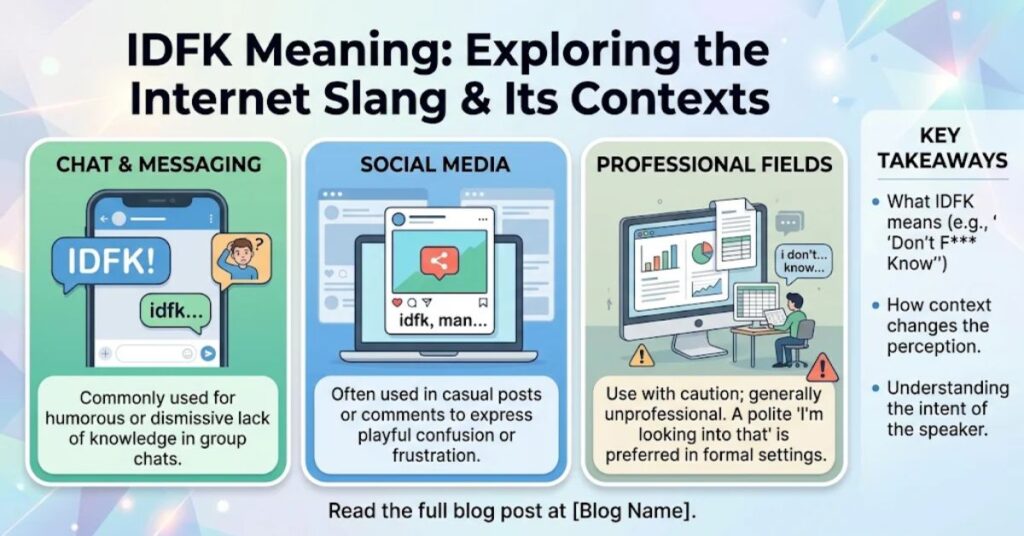
IDFK keeps the same basic meaning across different platforms. However, its tone can change depending on the conversation and the people involved. Someone might use it jokingly with friends or express genuine frustration during a stressful situation.
Understanding the setting helps you interpret the message correctly.
Casual Chat
Friends often use IDFK during everyday conversations. It provides a quick way to admit uncertainty without typing a complete sentence. Depending on the relationship, it can sound funny, relaxed, or slightly frustrated.
For example:
Friend: What should we order tonight?
You: IDFK. You always choose better food.
People also use it when they genuinely cannot answer a question.
Common situations include:
- Making plans with friends.
- Discussing unexpected situations.
- Answering difficult questions.
- Joking about confusing experiences.
Because it contains an explicit word, IDFK works best between close friends who feel comfortable using profanity.
Social Media
Social media users frequently include IDFK in comments, captions, and memes. It helps express reactions without writing long explanations. You’ll often see it when someone shares something confusing, surprising, or unexpectedly funny.
For example:
- IDFK why this video makes me laugh.
- IDFK what happened in that episode.
- IDFK how people manage everything.
The abbreviation also appears in Instagram comments, TikTok discussions, and Reddit posts. Sometimes users add LOL or NGL to make their reactions sound more casual.
Its meaning stays consistent, but the surrounding post helps explain the intended emotion.
Gaming
Gaming communities use plenty of texting abbreviations during multiplayer matches. IDFK can help players communicate uncertainty quickly without interrupting the action.
For example:
Player 1: Where did the enemy go?
Player 2: IDFK. Check the building behind you.
Gamers might also use it when they don’t understand an unexpected event or can’t identify an opponent’s location.
Common gaming situations include:
- Searching for missing teammates.
- Discussing confusing gameplay.
- Reacting to unexpected losses.
- Asking about unfamiliar game mechanics.
You’ll commonly encounter this slang in Discord servers and gaming chats. However, some players may prefer shorter alternatives like IDK.
Online Forums
Online forums such as Reddit give people space to discuss questions, opinions, and personal experiences. IDFK sometimes appears when someone doesn’t have enough information to answer a discussion.
For example:
User 1: Why did the company change its entire design?
User 2: IDFK. Maybe customers wanted something different.
People may also use it jokingly when responding to unusual questions. However, tone matters because written messages don’t always communicate emotions clearly.
In serious discussions, a simpler phrase like I’m not sure can sound more respectful. The best choice depends on the topic and audience.
Professional Communication
IDFK generally doesn’t belong in workplace communication. Its explicit language can sound careless or disrespectful in formal conversations. Business emails, school assignments, and presentations usually require clearer and more appropriate wording.
Instead of writing IDFK, consider these alternatives:
- I’m not sure about that.
- I don’t know at the moment.
- I haven’t checked yet.
- Let me confirm that.
- I’ll check and get back to you.
Example:
Colleague: Do we have the updated sales figures?
Instead of: IDFK.
Write: I haven’t checked yet. I’ll confirm the figures shortly.
These alternatives communicate uncertainty without creating an uncomfortable impression.
Meaning in Chat, WhatsApp, Instagram, TikTok
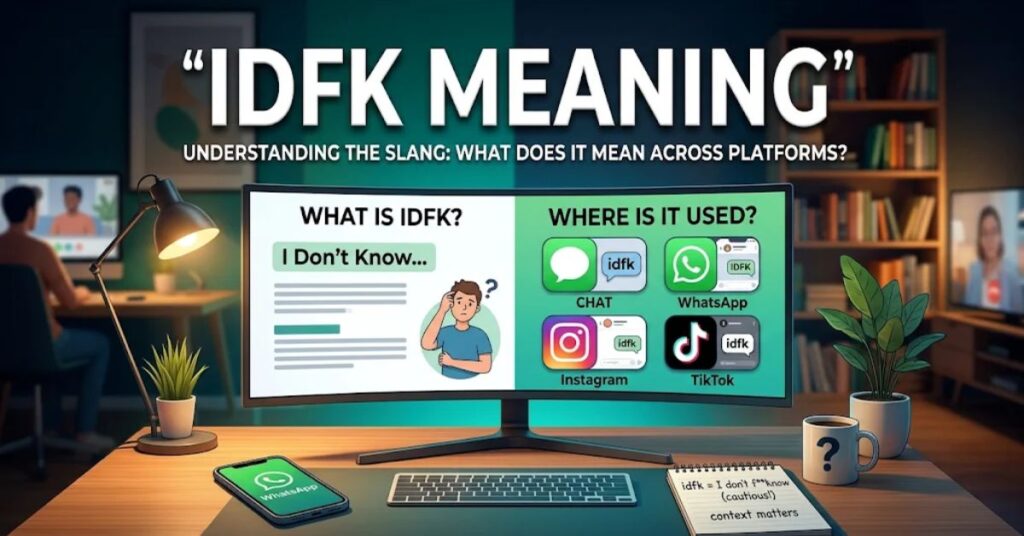
The idfk meaning remains I Don’t F*ing Know across messaging apps and social media platforms. However, people use it in different ways depending on the platform’s communication style.
It’s especially common in casual conversations where users want quick answers and stronger emotional expression.
Chat Messages
Text messages are among the most common places to encounter IDFK. People use it when answering unexpected questions or admitting they don’t know something.
For example:
Friend: What time does the movie start?
You: IDFK. I haven’t checked the tickets.
Sometimes, the abbreviation expresses frustration rather than simple uncertainty.
For example:
Friend: Why isn’t your phone connecting?
You: IDFK. It worked perfectly yesterday.
The surrounding conversation usually reveals whether someone sounds annoyed, confused, or playful.
WhatsApp users often include IDFK in private messages and group conversations. It offers a quick response when someone asks a question or requests an opinion.
For example:
Friend: Who’s bringing snacks to the party?
You: IDFK lol. Ask everyone in the group.
People also use it when making plans or discussing unexpected situations. Since WhatsApp conversations often involve friends and family, informal expressions can feel natural.
However, consider your audience before using profanity. Not everyone appreciates explicit language in everyday messages.
On Instagram, IDFK frequently appears in Story replies, comments, Reels captions, and meme pages. Users add it to express confusion or react to something surprising.
For example:
- IDFK what I was thinking yesterday.
- IDFK why this Reel is so funny.
- IDFK how she managed to do that.
Someone might also reply to an Instagram Story with IDFK when they cannot explain something.
The abbreviation works well in casual social media conversations. However, its meaning depends on the surrounding caption, image, or discussion.
TikTok
TikTok creators and viewers use IDFK in captions, comments, and POV videos. The abbreviation fits the platform’s quick and informal communication style.
People often include it when reacting to funny clips, unexpected situations, or confusing trends.
Examples include:
- POV: IDFK what’s happening anymore.
- IDFK why this trend is everywhere.
- IDFK how this video got so many views.
TikTok comments also use IDFK to express surprise or playful frustration. Sometimes creators combine it with LOL or NGL to make a reaction sound more expressive.
Meaning in Physics, Medical, and Aircraft Terminology
Although IDFK has a widely recognized meaning in internet slang, readers sometimes wonder whether it represents something different in specialized fields.
The abbreviation isn’t a standard technical term in physics, healthcare, or aviation. Its common meaning usually applies when someone uses it in casual online discussions.
Physics
IDFK isn’t a recognized standard abbreviation in physics. Scientists generally use established symbols, formulas, and terminology to explain scientific concepts.
You won’t normally find this expression in academic writing, physics textbooks, or research papers.
For example, if someone uses IDFK while discussing gravity or motion in an online forum, they’re probably using ordinary internet slang.
Example:
Student: Why does this object accelerate?
Friend: IDFK. Let’s check the physics notes.
Here, the abbreviation simply expresses uncertainty rather than describing a scientific concept.
Medical Field
IDFK isn’t a standard medical abbreviation used by healthcare professionals. Medical terminology requires clarity because misunderstandings can affect patient care and communication.
Doctors, nurses, and other healthcare professionals generally rely on standardized abbreviations in medical records and clinical discussions.
For example, a healthcare professional wouldn’t normally use IDFK to document an unknown diagnosis or treatment detail.
If you encounter IDFK in a medical-related online conversation, check the surrounding context. It most likely carries its familiar texting meaning rather than representing an official medical term.
Aviation or Aircraft
IDFK isn’t an official aviation code or standardized aircraft abbreviation. Pilots, air traffic controllers, and aircraft engineers use established terminology to communicate clearly.
Aviation communication requires accuracy because unclear messages can create serious safety risks.
For example, pilots don’t use casual texting expressions like IDFK when communicating operational information.
If someone writes IDFK in an aviation discussion or aircraft-related forum, they’re probably expressing uncertainty informally.
Technical conversations should always use recognized aviation terms rather than relying on internet slang.
Common Misconceptions
Internet slang can easily confuse people who encounter unfamiliar abbreviations. IDFK is no exception. Some readers misunderstand its full form or assume it always carries an aggressive tone.
Here are four common misconceptions worth understanding.
Misconception 1: It Means “I Don’t Feel Okay”
This is an incorrect interpretation of IDFK. The abbreviation stands for I Don’t F*ing Know rather than I Don’t Feel Okay.
People sometimes confuse the letters because they don’t recognize the explicit word in the middle.
For example:
Friend: Where did you put my headphones?
You: IDFK. I haven’t seen them.
The speaker is expressing uncertainty rather than explaining how they feel emotionally.
Misconception 2: It’s Always Rude
IDFK contains profanity, but that doesn’t mean everyone uses it aggressively. Among close friends, it can sound playful, humorous, or completely normal.
For example:
Friend: What’s your favorite food?
You: IDFK. I love everything!
Here, the speaker isn’t necessarily angry or disrespectful. They’re simply using casual emphasis.
However, tone and context matter. If someone sends IDFK during an argument, it might sound impatient or dismissive.
Misconception 3: Everyone Uses It
Not everyone feels comfortable using profanity in everyday conversations. Some people prefer simpler abbreviations or polite expressions instead.
Common alternatives include:
- IDK
- I’m not sure.
- No clue.
- I have no idea.
- I don’t know.
IDFK might be familiar across social media and texting communities. However, its popularity doesn’t make it suitable for every person or situation.
Your communication style and audience influence which expressions feel natural.
Misconception 4: It’s Appropriate Everywhere
Although IDFK works in informal conversations, it isn’t appropriate for every setting. Its explicit language can create an uncomfortable impression when used with unfamiliar people or professional contacts.
Avoid using it in:
- Business emails.
- School assignments.
- Formal presentations.
- Workplace communication.
- Professional meetings.
For example, instead of replying IDFK to your manager, say I’m not sure, but I’ll check.
Choosing suitable language helps you communicate clearly while respecting your audience.
Similar Terms & Alternatives
Several internet slang expressions communicate uncertainty, honesty, or frustration. However, they don’t all carry the same meaning as IDFK.
Understanding these related abbreviations helps you choose the right expression for different conversations.
| Abbreviation | Full Form | Meaning or Tone |
| IDK | I Don’t Know | Neutral uncertainty |
| IDC | I Don’t Care | Lack of interest |
| NVM | Never Mind | Dismissing a previous topic |
| IMO | In My Opinion | Sharing an opinion |
| TBH | To Be Honest | Expressing honesty |
| NGL | Not Gonna Lie | Introducing an honest reaction |
| SMH | Shaking My Head | Disappointment or disbelief |
| BRB | Be Right Back | Temporary absence |
| ICYMI | In Case You Missed It | Sharing previously available information |
| LOL | Laughing Out Loud | Amusement |
| BTW | By The Way | Introducing additional information |
If you want to express uncertainty without profanity, try these alternatives:
- I’m not sure.
- I’m unsure.
- I have no idea.
- No clue.
- I’m not certain.
- I don’t know at the moment.
- I haven’t checked yet.
- Let me think.
- I’ll figure it out.
- I’ll find out.
These phrases communicate the same general uncertainty without IDFK’s stronger emotional emphasis.
How to Respond to It
When someone sends IDFK, your response depends on their tone and the situation. They might genuinely lack an answer or simply be joking with you.
You don’t need to overthink every message. A natural response usually keeps the conversation moving.
If someone seems unsure:
- No worries.
- That’s okay.
- Let’s figure it out.
- I’ll check.
Example:
Friend: IDFK where the restaurant is.
You: No worries. Let’s look it up together.
If someone sounds frustrated:
- Don’t stress.
- We’ll find the answer.
- Let’s work it out.
- It’s okay. Take your time.
Example:
Friend: IDFK why my laptop keeps crashing.
You: Don’t stress. Let’s check what’s causing it.
If someone is joking:
- Fair enough.
- Same here!
- Me neither.
- Honestly, same.
Example:
Friend: IDFK why we’re still awake.
You: Same here. We should probably sleep!
The key is to understand their tone before replying. Most people use IDFK to express uncertainty rather than attack someone personally.
Differences from Similar Words
IDFK looks similar to several popular texting abbreviations. However, these expressions communicate different ideas and emotional reactions.
Understanding their differences helps prevent misunderstandings during online conversations.
IDK vs IDFK
IDK stands for I Don’t Know, while IDFK means I Don’t F*ing Know. Both expressions communicate uncertainty, but their emotional intensity differs.
IDK:
- Neutral and straightforward.
- Suitable for most casual conversations.
- Doesn’t contain profanity.
IDFK:
- Stronger and more expressive.
- Can communicate frustration or impatience.
- Contains an explicit word.
Example:
Friend: Where’s my phone?
You: IDK. Maybe check your bedroom.
Friend: Why isn’t the Wi-Fi working?
You: IDFK. It keeps disconnecting!
The main difference is emotional emphasis. IDFK adds stronger language to an otherwise ordinary answer.
IDC vs IDFK
IDC means I Don’t Care, while IDFK means I Don’t F*ing Know. Although both contain similar letters, their meanings are completely different.
IDC expresses a lack of interest or concern. IDFK communicates uncertainty or an inability to answer.
Example conversations:
Friend: Should we watch a comedy or horror movie?
You: IDC. You can choose.
Friend: Do you know who’s coming tonight?
You: IDFK. Nobody has confirmed yet.
Remember the distinction: IDC means you don’t care about something. IDFK means you don’t know something.
NVM vs IDFK
NVM stands for Never Mind. People use it when they want someone to ignore a previous question, comment, or request.
IDFK expresses uncertainty instead. It doesn’t necessarily mean the speaker wants to end the discussion.
Example conversations:
Friend: Can you send me that picture?
You: NVM. I already found it.
Friend: Why did Sarah leave early?
You: IDFK. I wasn’t there.
The difference is simple. NVM dismisses a topic or request while IDFK admits a lack of knowledge.
Relevance in Online Conversations & Dating Apps
Dating apps and online conversations rely heavily on short messages. People often use abbreviations like IDFK to communicate quickly without typing complete sentences.
Someone might use IDFK when discussing plans, choosing a restaurant, or deciding what to watch together.
For example:
Person 1: Where should we go for our first date?
Person 2: IDFK. Maybe somewhere with good coffee?
Person 1: That’s okay. I know a nice little café.
In this situation, IDFK expresses indecision rather than a lack of interest.
However, using profanity too frequently can affect your first impression. Someone who doesn’t know your texting style might interpret it as rude or careless.
Polite alternatives include:
- I’m not sure yet.
- I haven’t decided.
- Let me think.
- I’ll figure it out.
- What do you think?
Among close friends and established partners, IDFK might feel completely natural. With someone new, softer expressions can help maintain a friendly tone.
Understanding the context makes it easier to interpret someone’s intentions and avoid unnecessary misunderstandings.
Conclusion
Understanding the idfk meaning makes online conversations much easier. IDFK stands for I Don’t F*ing Know. It’s a stronger version of IDK and adds extra emotion to a simple reply. People use it to show confusion, frustration, surprise, or uncertainty. The idfk meaning can also sound playful when close friends use it jokingly. However, its tone depends on the conversation and the person sending it. It doesn’t always mean someone is angry or upset.
You may see IDFK in text messages, WhatsApp chats, Instagram comments, TikTok posts, and gaming conversations. Knowing the idfk meaning helps you understand the message before replying. Remember that it includes profanity, so it’s not suitable for every audience. Avoid using it in schoolwork, business emails, or formal conversations. When you need a polite option, try saying I’m not sure or I have no idea. Use IDFK only when the situation feels casual and appropriate.
FAQ’s
What does IDFK mean in texting?
IDFK means I Don’t F*ing Know. The idfk meaning expresses stronger confusion, frustration, or uncertainty than IDK.
Is IDFK rude to use?
IDFK contains profanity, so it can sound rude. Use it with close friends, not in formal or professional conversations.
What is the difference between IDK and IDFK?
IDK means I Don’t Know, while IDFK adds emphasis. The idfk meaning often shows stronger feelings or frustration.
How should you respond to IDFK?
Reply with No worries, Let’s figure it out, or Same here. Your response should match the conversation’s tone.
Does IDFK always mean someone is angry?
No, IDFK doesn’t always show anger. The idfk meaning can express humor, surprise, confusion, or genuine uncertainty depending on context.
