


Ever received a message containing IMK and wondered what it meant? You’re not alone. Short forms like this can make online conversations confusing, especially when you see an unfamiliar abbreviation. IMK usually stands for In My Knowledge. People use it to share information based on what they know. It also suggests that the information may not be completely certain. In simple words, it is similar to saying as far as I know or to my knowledge.
You may come across imk in chat on WhatsApp, Instagram, TikTok, and other messaging platforms. For example, someone might text, IMK, the meeting starts at 5 PM. They are sharing what they believe is correct without claiming to know everything. The phrase is mainly suited to casual conversations. However, it isn’t a standard formal expression. Knowing its meaning and tone can help you understand messages and reply with confidence.
Meaning & Definition: IMK Meaning in Text
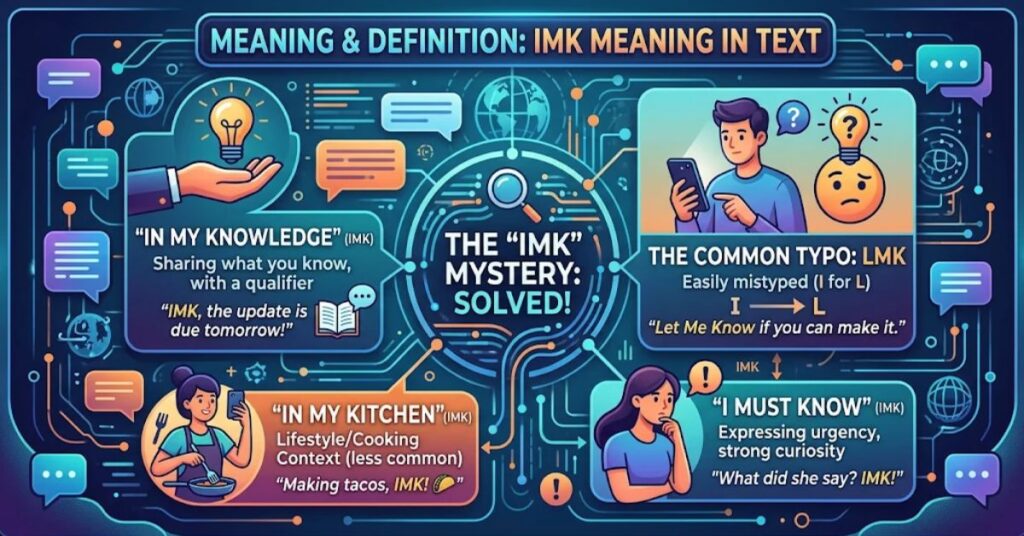
Have you received a message containing IMK and wondered what the sender meant? In casual online conversations, IMK is commonly used to mean In My Knowledge. It introduces information based on someone’s personal knowledge or current understanding. The expression is similar to saying as far as I know or to my knowledge.
People may use this texting abbreviation when sharing information without claiming complete certainty. It can suggest that their knowledge might be incomplete or not entirely up-to-date.
For example:
- Person A: Is the shop open today?
- Person B: IMK, yes. It closes at 9 PM.
Here, the sender shares what they believe is correct. The meaning of IMK still depends on context and surrounding words.
IMK vs. I Know
Although IMK and I know look similar, they communicate slightly different ideas. IMK introduces information based on personal knowledge. Meanwhile, I know expresses direct awareness or confidence about something.
For example:
- IMK: IMK, Sarah has already submitted the assignment.
- I know: I know Sarah submitted the assignment yesterday.
The first statement leaves room for incomplete information. The second sounds more definite.
You might notice this difference during casual conversations or online discussions. Someone using IMK may want to avoid sounding overly confident.
However, IMK isn’t a universally recognized abbreviation. Some readers may find its expansion unusual because English speakers generally prefer to my knowledge or as far as I know.
Is IMK Formal?
No, IMK is mainly associated with informal communication. You may encounter it in text messages, group chats, social media comments, and casual conversations. Friends sometimes use it when sharing information quickly without typing a complete expression.
However, the abbreviation isn’t suitable for every situation. In professional communication, readers may not recognize its meaning. Using unfamiliar texting slang can also create unnecessary confusion.
Avoid IMK in:
- Business emails and official reports.
- Academic essays and professional presentations.
- Legal documents and formal correspondence.
- Important workplace discussions.
Instead, use expressions such as to my knowledge or to the best of my knowledge. These alternatives sound clearer and more professional.
Background: IMK Meaning in Text
Texting abbreviations became popular as people looked for quicker ways to communicate. Shortened expressions helped users save time while sending messages through phones and online platforms.
Common examples include LOL, BTW, IDK, IMO, and TBH. IMK follows a similar abbreviation pattern and represents the phrase In My Knowledge in the texting usage discussed here.
However, IMK isn’t as widely recognized as many established internet slang terms. Its exact origin and first recorded use aren’t clearly established. Therefore, it’s better not to assign it a specific invention date or creator.
Another important detail involves natural English. People usually say as far as I know or to my knowledge instead of in my knowledge. Understanding this difference helps explain why some readers find IMK confusing.
Why Abbreviations Become Confusing
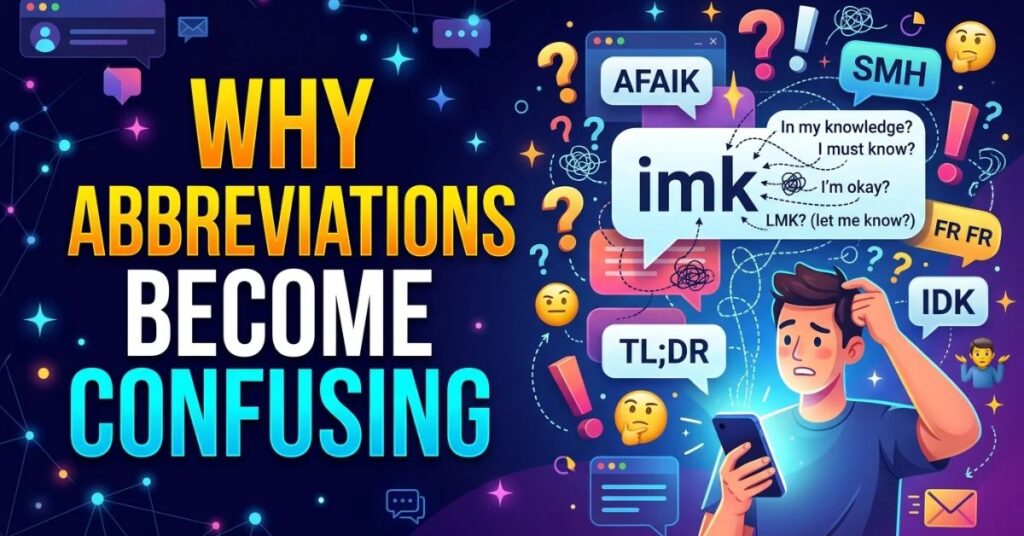
Internet slang changes quickly. A texting abbreviation can have different interpretations depending on the platform, community, and conversation.
Some shortened expressions become popular across social media. Others remain limited to smaller groups of friends or online communities. IMK can create confusion because its expansion isn’t universally familiar.
Several factors contribute to these misunderstandings:
- Multiple meanings: The same letters can represent different expressions.
- Community-specific slang: Certain groups develop their own texting language.
- Typing mistakes: Someone might accidentally enter the wrong letters.
- Missing context: A short message may not explain the sender’s intention.
- Technical terminology: Letter combinations can have specialized meanings.
When you encounter an unfamiliar abbreviation, examine the surrounding words. If the meaning remains unclear, asking for a polite clarification is usually the easiest solution.
Usage in Different Contexts
The meaning and tone of IMK can change depending on where someone uses it. In casual conversations, it generally introduces information based on personal knowledge.
For example, someone might write IMK, the event starts at 6. They’re sharing what they currently understand rather than making an absolute claim.
You may encounter this abbreviation in private messages, social media discussions, and online forums. However, its use in professional communication requires more care.
Consider these situations:
- Friends: Sharing information about plans or events.
- Group chats: Answering questions when information might change.
- Social media: Responding to comments or online discussions.
- Workplace conversations: Informally sharing information with coworkers.
Always consider the audience before using unfamiliar texting slang. Clear communication matters more than saving a few keystrokes.
Chat, Social Media, and Professional Fields
IMK can appear in several communication settings. Its intended meaning generally depends on the surrounding conversation rather than the platform itself.
In casual chat, someone might use it before sharing information. On social media, users may include it in comments or direct messages when answering questions.
For example:
- Text message: IMK, Jake is coming tonight.
- Instagram: IMK, this trend started last year.
- Online forum: IMK, the update is available now.
- Workplace chat: IMK, the report was submitted yesterday.
Professional fields require additional attention. Even when coworkers understand texting abbreviations, IMK may sound too casual for important discussions.
In business emails or official reports, write as far as I know instead. This keeps your message clear and avoids unnecessary misinterpretation.
When IMK Works Well
IMK works best when you want to share information in an informal setting. It can introduce a statement without suggesting that you know every detail.
For instance, imagine a friend asking whether a restaurant remains open. You remember seeing its opening hours recently but haven’t checked again.
You might respond:
- Person A: Is the restaurant still open?
- Person B: IMK, yes. It closes at 10.
This makes your confidence level easier to understand.
IMK may work well when:
- You’re chatting with friends.
- You’re answering questions in group chats.
- You’re participating in casual online discussions.
- You’re sharing information that could change.
- The other person understands the abbreviation.
Still, use complete expressions whenever clarity matters.
When to Avoid It
Although IMK can fit casual conversations, some situations call for clearer language. Not everyone understands internet slang or shortened expressions.
Using unfamiliar abbreviations can make important information harder to interpret. This becomes especially problematic when accuracy matters.
Avoid IMK in:
- Academic essays and formal writing.
- Legal documents and official reports.
- Business emails to unfamiliar readers.
- Professional presentations.
- Important healthcare discussions.
- Messages requiring precise confirmation.
For example, writing IMK, the payment was received may create uncertainty. A clearer alternative is to write To the best of my knowledge, the payment was received.
Choose language that matches your audience. A complete expression often communicates your meaning more effectively.
Meaning in Chat
When discussing IMK in chat, the intended meaning is generally In My Knowledge. People use it to introduce information based on what they currently know.
It can also function as hedging language. This means the sender avoids presenting information as completely certain when they might lack some details.
Consider this conversation:
- Person A: Does David still work at that company?
- Person B: IMK, yes. He hasn’t mentioned leaving.
Person B believes David still works there but doesn’t claim to have confirmed it.
You may see similar messages in private conversations, messaging apps, and group discussions. However, IMK isn’t universally understood. If someone uses it differently, the surrounding words can help reveal their intended meaning.
WhatsApp, Instagram, and TikTok
Social media creates plenty of opportunities for shortened expressions. IMK may appear in WhatsApp messages, Instagram comments, TikTok discussions, and other online conversations.
The platform doesn’t automatically change its intended meaning. Context and speaker intent remain important.
Here are a few examples:
WhatsApp:
- Friend: Is Ali joining us tonight?
- You: IMK, yes. He confirmed yesterday.
Instagram:
- User: Is this the original video?
- Reply: IMK, yes. I saw it last week.
TikTok:
- User: Did she start this trend?
- Reply: IMK, she posted something similar first.
You might also encounter unfamiliar abbreviations on Snapchat or Facebook. Don’t assume every user understands IMK in the same way. When necessary, ask what they mean.
How to Use IMK Correctly in Conversations
If you want to use IMK naturally, place it before information that reflects your current understanding. It can introduce an answer while leaving room for missing or outdated details.
For example:
- IMK, the meeting starts at 11.
- IMK, she already sent the invitation.
- IMK, the store closes early on Sundays.
- IMK, they’re still planning the trip.
You can also use it in a short conversation:
- Person A: Has the new update arrived?
- Person B: IMK, yes. I downloaded it yesterday.
Keep a few things in mind:
- Use it mainly in informal communication.
- Make sure the other person understands texting slang.
- Don’t use it to replace verified information.
- Consider whether your statement needs confirmation.
Remember that In My Knowledge sounds less natural in standard English than to my knowledge. Choose the complete expression when writing for a wider audience.
Meaning in Physics, Medical, and Aircraft Terminology
IMK may appear in documents outside ordinary texting. However, its appearance doesn’t automatically establish a technical definition.
Physics, medical terminology, aviation, and engineering all use abbreviations, symbols, labels, and identifiers. Some belong to specific organizations or individual research projects.
For example, a research paper might define a particular abbreviation within its terminology section. An aircraft manual may also contain codes used for a specific system.
Therefore, don’t automatically interpret every appearance of IMK as In My Knowledge.
Consider these points:
- Check the document’s abbreviation list.
- Read the surrounding technical explanation.
- Identify the relevant field-specific meaning.
- Avoid guessing unfamiliar terminology.
- Ask a qualified professional when necessary.
Context helps distinguish internet slang from specialized technical language.
Physics
Physics uses many symbols and shortened terms to explain scientific concepts. You’ll encounter abbreviations in textbooks, laboratory documents, research papers, and technical diagrams.
However, IMK isn’t a universally established standard physics abbreviation with one generally accepted definition. Its meaning may depend on a particular author, experiment, or technical system.
For example, if you notice IMK in a scientific material, examine the surrounding equations and explanations. The letters might represent a local identifier or a term defined within that document.
Don’t automatically assume the texting meaning applies.
If the document contains an abbreviation list, check it first. Otherwise, consult the author or relevant technical reference before interpreting the letters.
Medical Terminology
Medical terminology contains many abbreviations used in medical records, clinical discussions, and healthcare documents. Some abbreviations can carry different meanings across specialties.
IMK doesn’t have one universally accepted medical meaning that should be assumed whenever you encounter it.
For example, you might notice these letters in a medical device manual or research paper. Their meaning could depend on the manufacturer, hospital, or specific clinical context.
When dealing with unfamiliar medical abbreviations:
- Check the document’s terminology guide.
- Review the surrounding clinical information.
- Avoid guessing the intended meaning.
- Ask a qualified healthcare professional for clarification.
Accuracy matters in healthcare. Never interpret an unfamiliar abbreviation in important medical records using texting slang alone.
Aircraft and Aviation Terminology
Aviation relies on precise communication. Pilots, engineers, and ground crews use specialized abbreviations throughout aircraft manuals, flight documents, and navigation materials.
However, IMK shouldn’t automatically be treated as a standard aviation term. Its meaning would need confirmation from the relevant document or aviation reference.
For example, a technical diagram might contain several letter combinations representing equipment labels or system identifiers. Their definitions may appear in the accompanying documentation.
If you encounter IMK in an aviation setting, consider:
- The type of aircraft document.
- The surrounding technical information.
- Any listed symbols or abbreviations.
- The relevant aviation reference material.
Never rely on a casual texting definition when interpreting important flight information. Technical accuracy should always come first.
Common Misconceptions
Several misconceptions can make IMK difficult to understand. The biggest one involves confusing it with other familiar texting abbreviations.
First, IMK doesn’t mean IDK. IDK stands for I Don’t Know, while IMK is used for In My Knowledge in the texting context discussed here.
Another misconception is that IMK always expresses doubt. It can suggest limited knowledge, but the sender might still feel confident about the information.
Here are a few common misunderstandings:
- IMK means I don’t know: This is incorrect. IDK carries that meaning.
- IMK is always romantic: It isn’t generally a romantic abbreviation.
- IMK is formal English: It’s mainly associated with informal communication.
- Every user understands it: Some readers may not recognize it.
- It has one meaning everywhere: Technical contexts require separate interpretation.
Always consider context, tone, and surrounding words before deciding what someone means.
Similar Terms & Alternatives
IMK has several natural alternatives in everyday English. These expressions communicate similar ideas without relying on unfamiliar texting slang.
The best choice depends on your confidence level and the situation. Some alternatives sound casual while others fit professional communication better.
Common options include:
- As far as I know.
- To my knowledge.
- As far as I’m aware.
- I believe.
- I think.
- To the best of my knowledge.
For example, instead of writing IMK, the office closes at 5, you could say As far as I know, the office closes at 5.
These alternatives often sound more natural to English speakers. They’re also easier to understand in business emails and other formal settings.
As Far as I Know
As far as I know is one of the most natural alternatives to IMK. People use it when sharing information based on what they currently understand.
It suggests that the speaker has some knowledge but might not know every detail. This makes it useful when answering questions about plans, schedules, and everyday situations.
For example:
- Person A: Is the event still happening tomorrow?
- Person B: As far as I know, yes.
The expression sounds natural in casual conversations and many professional settings. It also communicates uncertainty without making the speaker sound completely uninformed.
If you’re unsure whether someone understands IMK, this phrase is a safer choice.
To My Knowledge
To my knowledge is another close alternative. It introduces information that the speaker believes is accurate based on available facts or personal understanding.
Compared with as far as I know, this expression can sound slightly more formal. You may encounter it in workplace discussions, professional communication, and everyday conversations.
For example:
- Person A: Has anyone reported a problem?
- Person B: To my knowledge, nobody has.
The phrase doesn’t guarantee that the information is complete. It simply explains the speaker’s current understanding.
Use it when you want to sound careful and clear. It’s especially useful in situations where accuracy matters more than texting convenience.
As Far as I’m Aware
As far as I’m aware is another natural way to express limited knowledge. It tells someone that your statement reflects the information currently available to you.
This phrase works well when discussing schedules, plans, workplace updates, or changing situations.
For example:
- Person A: Has the deadline changed?
- Person B: As far as I’m aware, it’s still Friday.
The speaker isn’t claiming to have checked every possible update. They’re sharing what they currently understand.
Unlike an unfamiliar texting abbreviation, this expression is widely understandable. You can use it in casual messages or professional conversations without worrying about whether the reader recognizes internet slang.
I Believe
I believe is useful when you want to express a personal understanding or judgment. It can introduce information that you consider likely to be correct.
However, it emphasizes belief rather than knowledge. That’s an important difference when comparing it with IMK.
For example:
- Person A: Does the store open at 8?
- Person B: I believe it opens at 8.
The answer suggests that the speaker thinks the information is correct but hasn’t necessarily confirmed it.
You can use I believe in everyday conversations and professional communication. It also sounds more natural than forcing an unfamiliar abbreviation into a formal sentence.
I Think
I think is one of the most common expressions in everyday English. People use it to share opinions, guesses, or information they’re not completely certain about.
For example:
- Person A: Is Sarah coming to the party?
- Person B: I think she’s coming.
Unlike IMK, this phrase doesn’t directly emphasize personal knowledge. Instead, it highlights the speaker’s belief or judgment.
I think also works well when discussing preferences and opinions.
For example, I think this movie is better than the first one expresses a personal view rather than verified information.
Choose this alternative when your message reflects an opinion instead of something you know.
Quick Comparison
Although these expressions can communicate similar ideas, they aren’t always interchangeable. Each one carries a slightly different tone and level of certainty.
| Expression | Meaning or purpose | Tone |
| IMK | In My Knowledge | Informal |
| As far as I know | Based on current knowledge | Natural and neutral |
| To my knowledge | Based on available knowledge | Slightly formal |
| As far as I’m aware | Based on current awareness | Neutral |
| I believe | Expresses personal belief | Thoughtful |
| I think | Expresses an opinion or judgment | Casual |
For everyday texting, as far as I know is usually the clearest alternative. In professional communication, to my knowledge often works better.
Choose the phrase that accurately reflects what you know. That small distinction can prevent misunderstandings.
How to Respond to IMK
Your response to IMK depends on the information someone shares. You don’t need to discuss the abbreviation itself when you already understand the message.
For example:
- Them: IMK, the class is canceled.
- You: Thanks for letting me know!
If you’re unsure about the information, ask a follow-up question. This helps you understand the sender’s confidence level.
You could respond with:
- Are you sure?
- Do you know for certain?
- Can you confirm that?
- Should we check with someone?
When the message is important, don’t rely entirely on an uncertain statement. A quick confirmation can prevent unnecessary confusion.
If you don’t understand IMK, asking what it means is perfectly acceptable.
Friendly Responses
Sometimes a simple response is enough. If someone uses IMK while sharing ordinary information, you can acknowledge their message without making the conversation complicated.
Here are some friendly replies:
- Thanks for letting me know!
- Good to know.
- Got it.
- Thanks for the info.
- I’ll check too.
- That makes sense.
- Okay, sounds good.
- Appreciate the update.
For example:
- Person A: IMK, the restaurant closes at 10.
- Person B: Good to know. Thanks!
If the information affects your plans, consider asking for confirmation.
You might say Are you sure the closing time hasn’t changed? This keeps the conversation friendly while making sure everyone has accurate information.
Differences from Similar Words
IMK can look similar to other popular texting abbreviations. However, these shortened expressions serve different purposes.
Understanding their differences makes fast-moving conversations easier to follow. It also helps you avoid confusing personal knowledge with opinions or a lack of information.
Some related abbreviations include:
- IDK: I Don’t Know.
- IMO: In My Opinion.
- IMHO: In My Humble Opinion.
- FYI: For Your Information.
- TBH: To Be Honest.
Each abbreviation communicates a different intention. Some introduce opinions while others share information or express honesty.
Let’s compare them individually so you can recognize the difference in everyday messages.
IMK vs. IDK
IMK and IDK look similar, but their meanings are different. IMK refers to In My Knowledge in the texting usage discussed here. IDK stands for I Don’t Know.
The difference is simple: one introduces information while the other expresses a lack of knowledge.
For example:
- IMK: IMK, the meeting starts at 10.
- IDK: IDK when the meeting starts.
In the first message, the sender believes the meeting starts at 10. In the second, the sender doesn’t know the starting time.
This distinction matters when reading short messages. Mixing up these abbreviations could completely change the meaning of someone’s response.
IMK vs. IMO
IMO stands for In My Opinion. People use it when expressing personal views rather than sharing information based on knowledge.
IMK, in contrast, introduces information the sender believes they know.
Consider these examples:
- IMK: IMK, the restaurant opened in 2020.
- IMO: IMO, this restaurant serves the best pizza.
The first statement concerns information. The second expresses a personal opinion.
You might see both abbreviations in group chats, online forums, and social media discussions.
Remember this simple distinction: IMK relates to personal knowledge while IMO introduces an opinion. Their similar appearance doesn’t make them interchangeable.
IMK vs. IMHO
IMHO stands for In My Humble Opinion. It’s commonly used when someone wants to express an opinion in a modest or less forceful way.
IMK has a different purpose. It introduces information based on what the speaker currently knows.
For example:
- IMK: IMK, the new update arrived yesterday.
- IMHO: IMHO, the previous version looked better.
The first message shares information. The second communicates a personal judgment.
Both abbreviations appear in informal online discussions. However, they serve different roles in a sentence.
If you’re expressing a preference or personal judgment, IMHO is more appropriate. If you’re sharing information based on your understanding, IMK may fit the intended meaning.
IMK vs. FYI
FYI means For Your Information. People use it when sharing something they think another person should know.
IMK introduces information based on personal knowledge. FYI simply highlights that the information may be useful or relevant to the reader.
For example:
- IMK: IMK, the meeting starts at 3 PM.
- FYI: FYI, the meeting has moved to 3 PM.
The first statement qualifies the sender’s knowledge. The second passes along an update.
You may encounter both abbreviations in workplace chats, emails, and group conversations.
Remember that FYI doesn’t necessarily express uncertainty. It’s mainly used to bring useful information to someone’s attention.
IMK vs. TBH
TBH stands for To Be Honest. It’s commonly used before an honest opinion, reaction, or personal statement.
IMK serves a different purpose because it introduces information based on someone’s knowledge.
For example:
- IMK: IMK, Jake already knows about the plan.
- TBH: TBH, I don’t really like the plan.
The first message communicates information the sender believes is correct. The second expresses an honest personal reaction.
Both abbreviations appear in texting slang and social media conversations. However, their tone and meaning aren’t the same.
Use TBH when emphasizing honesty. Choose IMK when sharing information based on your current understanding.
Relevance in Online Conversations & Dating Apps
Dating apps and social media encourage quick, informal communication. People often use shortened expressions to keep messages brief and conversations moving.
IMK may appear in messages on Tinder, Bumble, Hinge, WhatsApp, or Instagram. Its intended texting meaning generally remains In My Knowledge.
For example:
- Person A: Does she still live nearby?
- Person B: IMK, yes. She mentioned it recently.
The sender is sharing information based on what they currently know.
However, dating conversations often involve subtle changes in tone. A short abbreviation might sound less certain than a complete sentence.
When arranging a date or discussing plans, don’t rely on assumptions. Ask for confirmation whenever important details remain unclear.
Does IMK Have a Romantic Meaning?
No, IMK doesn’t generally have an established romantic or flirtatious meaning. It’s not commonly recognized as a secret dating code or a hidden message expressing attraction.
If someone sends IMK during a dating conversation, the abbreviation usually serves its ordinary texting purpose.
For example:
- Person A: Is your friend still single?
- Person B: IMK, yes. She hasn’t mentioned dating anyone.
This message shares information rather than expressing romantic interest.
However, tone and surrounding words still matter. People sometimes combine ordinary abbreviations with flirting or playful language.
Don’t assume that IMK carries a special romantic meaning simply because someone uses it on Tinder, Bumble, Hinge, or another dating platform.
Why Context Matters on Dating Apps
Dating messages are often short and informal. People use abbreviations, emojis, and casual expressions to communicate quickly.
Because of this, the same message can sound different depending on the surrounding conversation.
For example:
- Person A: Are we still meeting at 7?
- Person B: IMK, yes.
The reply suggests that the person believes the arrangement remains unchanged. However, it doesn’t provide complete confirmation.
If you’re arranging a date, it’s better to clarify important details.
You could respond:
- Just confirming we’re still meeting at 7?
- Has anything changed?
- Should I book the table?
Pay attention to tone and speaker intent rather than assuming a hidden message. Clear communication makes dating conversations much easier.
When You Should Not Use IMK
Although IMK can appear in casual messages, it isn’t suitable for every audience or situation. Some people may not recognize the abbreviation or understand its intended meaning.
Avoid using it when your message requires accuracy, clarity, or a professional tone.
For example, IMK, the contract was approved sounds less appropriate in an official email. A clearer option is To the best of my knowledge, the contract was approved.
You should generally avoid IMK in:
- Legal documents and official reports.
- Academic essays and research papers.
- Business emails to unfamiliar readers.
- Professional presentations.
- Important healthcare communication.
- Technical instructions and formal records.
Choose complete expressions when communicating important information. Clear wording reduces confusion and helps readers understand exactly what you mean.
FAQs
What does IMK mean in text messages?
IMK usually stands for In My Knowledge. People use it to share information they believe is correct. It is similar to saying as far as I know.
What does IMK mean on WhatsApp?
On WhatsApp, IMK has the same meaning: In My Knowledge. Someone might use it in a private message or group chat to share information without sounding completely certain.
What does IMK mean on Instagram?
On Instagram, IMK can appear in direct messages, comments, or casual conversations. It usually means In My Knowledge and shows that someone is sharing what they currently believe.
Is IMK the same as IDK?
No. IMK usually means In My Knowledge, while IDK means I Don’t Know. IMK shares what someone believes they know. IDK expresses a lack of knowledge.
What does IMK mean in dating?
In dating messages, IMK generally has the same meaning. It doesn’t have a special romantic or secret meaning. The surrounding conversation helps explain the sender’s intention.
Is IMK formal English?
No. IMK is an informal texting abbreviation. Avoid using it in business emails, academic essays, official reports, or professional documents. Use as far as I know instead.
What is another way to say IMK?
You can use several natural alternatives:
- As far as I know
- To my knowledge
- As far as I’m aware
- To the best of my knowledge
- I believe
- I think
Can IMK have a technical meaning?
It may appear as an abbreviation in specialized fields such as medicine, physics, or aviation. However, its meaning depends on the specific document or industry. Don’t assume it means In My Knowledge in every technical context.
Conclusion
Understanding imk in chat makes online conversations easier. IMK usually stands for In My Knowledge. People use it when sharing information they believe is correct. It also shows that they may not know every detail. You can see imk in chat on WhatsApp, Instagram, TikTok, and other messaging apps. Its meaning usually stays the same across these platforms. However, always consider the surrounding words before deciding what someone means.
Remember that imk in chat is an informal expression. It works best in casual messages with friends and familiar people. It isn’t the same as IDK and doesn’t have a special romantic meaning. You can use phrases like as far as I know or to my knowledge instead. These alternatives sound clearer in professional settings. Once you understand imk in chat, you’ll find it easier to read messages and respond with confidence.
